
If you’ve ever tried to review Indigenous America with your middle schoolers and found yourself facing blank stares, mixed-up timelines, and students insisting the Aztecs lived in New York, you are not alone. Indigenous America is one of those units that students love… but somehow still manage to confuse every chance they get. It’s a rich, complex period of history that deserves attention, nuance, and accuracy — but when test prep rolls around, it can feel like you’re suddenly climbing a mountain with the whole class strapped to your back.
That’s exactly why I created an Indigenous America review game. I wanted something that didn’t require me to stand at the front of the room explaining differences between regions for the tenth time, and something that didn’t put students into “worksheet mode.” This game is the tool that finally helped everything click for my students — and made test prep a whole lot smoother for me.
Let’s talk about why this topic is so tricky, what students really need to understand, and how a simple interactive review game can transform your Native American Societies test prep.

Why Indigenous America Test Prep Feels So Tricky
I used to think the hardest part of teaching Indigenous America was the sheer range of cultural diversity. Then I realized the real challenge was helping students keep everything straight. They mix up regions constantly (“Wait, the Pueblos used totem poles, right?”), they confuse pre-contact Indigenous history with later colonization, and they often assume all Native American societies lived the same way.
And the thing that frustrated me most? They actually want to understand this unit. They’re fascinated by the Maya, Aztec, and Inca. They love talking about how the environment shapes culture. They ask thoughtful questions. But when the test is two days away, the details start slipping.
Traditional review methods didn’t help. Packets bored them. Study guides overwhelmed them. Reading through notes again? Forget it. I needed something more active and meaningful — something that matched the energy students naturally bring to this unit.
That’s where the review game came in.
What Students Need to Know About Indigenous America (Before Contact)
Before students can succeed on an Indigenous America unit test, they need a clear picture of life in North America before Europeans arrived — a time of incredible cultural diversity, innovation, and adaptation.
I always remind my students that Indigenous America wasn’t a single culture or a single timeline. It was thousands of years of development shaped by the environment, community needs, and, frankly, human creativity. The Eastern Woodlands looked nothing like the Plains. The Southwest wasn’t anything like the Pacific Northwest. Students need to understand how the environment shaped everything from food and housing to tools, social structures, and belief systems.
We also spend time comparing Indigenous North America to the great early civilizations of the Americas — the Maya, Aztec, and Inca. Even though those societies weren’t in the United States, curriculum often mixes them in, so I intentionally address them in review.
Of course, misconceptions still pop up. Students often assume all Indigenous groups lived in teepees or hunted buffalo. Others struggle to place the timeline of Indigenous civilizations in relation to European arrival. And many don’t realize how early forms of agriculture transformed life long before colonization.
The more we talk through these ideas, the more I see how important it is for students to practice the content in an active way — not just read about it.
Why Review Games Work So Well for Middle School Social Studies
Middle schoolers want to move, talk, guess, debate, and test their knowledge — and honestly, they learn best when they’re doing exactly that. A review game taps into their natural energy and turns it into something productive.
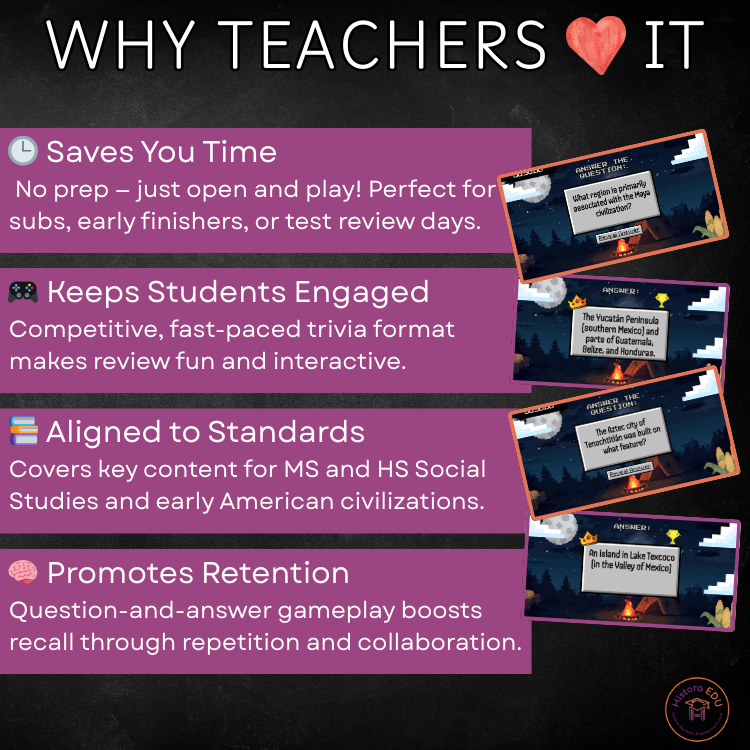
With this game, students aren’t passively memorizing facts. They’re retrieving information, checking their understanding, and refining what they know in real time. They get immediate feedback without the pressure of a quiz grade. And the best part? They’re actually having fun. I hear groans when the bell rings because they want “just one more question.”
For teachers, the appeal is simple: it’s low prep. Once the game was created, I could use it every year without tweaking a thing. Whether I projected it for whole-class play, assigned it in stations, or let students compete in teams, it made test prep something I actually looked forward to — not something I slogged through.
This game has now become one of my favorite tools for middle school social studies test prep because it engages students, saves time, and builds confidence. And honestly? Those three things are a rare combination.
Inside the Indigenous America Review Game
This review game covers all the major content students need for an Indigenous America test. It includes 60 classroom-ready questions that help students review everything from regional differences and cultural adaptations to early farming innovations, civilizations like the Maya, Aztec, and Inca, and the diversity of Indigenous belief systems.
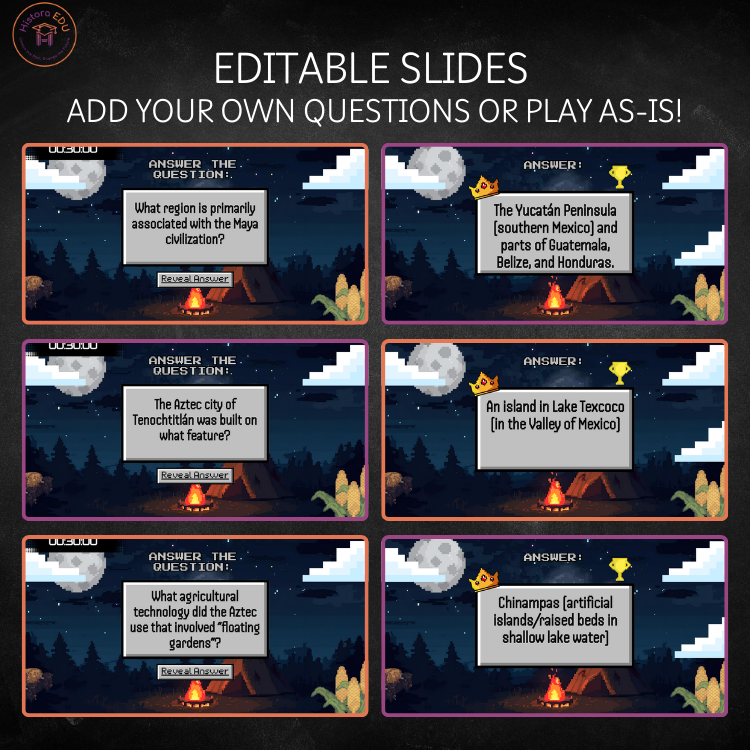
Teachers receive an interactive digital version of the game, a student-ready gameplay link, and an editable version if you want to customize anything. It works best for grades 6–8, though it can be used as a quick refresher in your high school American History or AP U.S. History classes!
The game itself is easy to run. You can project it to the whole class, let students work in groups, or set it up as a station activity. I’ve used it in classes with 25 minutes left in a period or as a full 40-minute review block — it fits whatever time you have.
👉 You can grab the Indigenous America Review Game here on TPT if you want to follow along.
How to Use This Indigenous America Review Game in Your Classroom
There’s no one right way to run a review game like this, which is one of the reasons teachers love it.
One of my favorite approaches is a whole-class game day. I divide students into teams, hand out whiteboards, and let them take ownership of answering questions. It becomes noisy, energetic, and incredibly effective — especially the day before the test. Students realize quickly which regions or concepts they’ve mixed up, and their teammates help them correct misunderstandings.
I also use this game during stations or rotations when I want to differentiate. While one group is analyzing maps or reading short primary sources, another group plays the review game. It adds variety and keeps engagement high, especially for students who need hands-on or interactive learning.
For students who were absent or who need extra reinforcement, the game works beautifully as independent or small-group practice. They get the structure and content review without feeling singled out for remediation.
And yes — it’s a fantastic sub plan. It requires almost no explanation, and even on days I’m unexpectedly out, I know my students will get meaningful review instead of busywork.
If you need something low-prep that still feels intentional and effective, this game is the perfect fit.
Differentiation & Support Ideas
One of the things I love about using a review game is that it naturally supports different learners. You can let students work in pairs if they need support, or let them reference notes during the first round if their confidence is low. You can even pull individual questions from the game and use them as bell ringers or exit tickets leading up to the test.
If you want to extend the activity into writing or reflection, I often end the period by having students reflect on their learning. A simple “3 things you learned, 2 questions you still have, 1 misconception you corrected” prompt brings everything together and helps students identify what they still need to study.
And if you want to incorporate more writing, a quick prompt like “Explain one example of how an Indigenous group adapted to its environment” helps students connect factual knowledge to historical reasoning.
These small extensions make the review game feel like a full, thoughtful learning experience rather than a stand-alone activity.
Where to Get the Indigenous America Review Game (+ Future Resources)
If you’re ready to make your test review more engaging and less stressful, you can find the full game here:
👉 Indigenous America Review Game | Native American Societies Quiz & Test Prep
If you teach 7th or 8th grade U.S. History, this game is also part of two larger bundles designed to save you planning time and give you a complete, ready-to-teach review system for the entire year.
This bundle includes all the major review games for the first half of U.S. History, so you never have to scramble for test prep again — Indigenous America, Exploration, Colonization, 13 Colonies, American Revolution, Constitution, and more. It’s perfect if you want consistent, interactive, low-prep review days built right into your pacing.
If you’re ready to completely streamline your year, this bundle covers every unit from day one through the end-of-year final exam. Every review game follows the same structure, the same look, and the same ease-of-use — which means your students always know what to expect, and you always have a reliable test prep tool at your fingertips.
Teachers who use the full bundle often tell me it becomes their go-to resource for quizzes, sub plans, stations, test prep, and even informal assessments throughout the year.
And if you want free resources, teaching tips, and exclusive discounts, join the HistoraEDU teacher community below. You’ll get access to my Teacher Toolkit, early product releases, classroom-tested strategies, and seasonal freebies sent right to your inbox.
📬 Join the HistoraEDU Email List
Where history teachers get smarter strategies — not more work.
Whether you’re here for engaging lessons, low-prep review games, or just a spark of inspiration on a long Tuesday afternoon, I’m glad you’re part of this community. More resources, classroom stories, and ready-to-teach materials are on the way — and I can’t wait to share them with you!
Happy teaching,
Sarah @ HistoraEDU


