
If you’ve ever taught a European Colonization unit, you already know the moment I’m about to describe. You wrap up weeks of instruction — rich discussions about motives, global competition, Indigenous resistance, early settlements, and new economic systems — and you feel good about it. Students seemed engaged. Discussions were lively. They nodded along, took notes, and seemed to “get it.”
And then… review day arrives.
Suddenly, students are mixing up Spain and France. They can’t quite remember why the English settled Jamestown or what mercantilism actually meant. They confuse colonization with exploration, or they’re convinced the triangular trade involved… triangles drawn on maps for reasons they cannot explain.
European Colonization is fascinating, but it’s dense, interconnected, and easy for students to misinterpret or forget without meaningful practice. That’s exactly why I created this European Colonization Review Game: an interactive, student-centered way to help middle schoolers retain and understand what they’ve learned while making test prep something they actually look forward to.
Let’s walk through why this unit is tough, what students really need to know for a Colonization test, and how this review game can transform your review day into something engaging, memorable, and low prep.

Why the European Colonization Unit Can Be Hard for Students
European Colonization sits at an interesting crossroads in the social studies curriculum. It’s the bridge between early exploration and the rise of the 13 Colonies. It’s full of cause-and-effect relationships, competing European powers, and major cultural impacts — especially on Indigenous peoples.
In other words: it’s a lot.
Students often get stuck on a few common issues:
They confuse exploration and colonization.
Exploration involves voyages. Colonization involves settlement — but students mix timelines, goals, and events constantly.
They blend European powers together.
Spain, France, England, and the Netherlands each had distinct motives, relationships with Indigenous peoples, and settlement patterns. Students rarely keep those differences straight without repeated review.
They misunderstand motivations.
Some assume Europeans colonized only for wealth. Others think it was only for religion. Many don’t realize how politics, competition, and trade shaped decisions.
They struggle with long-term impact.
Colonization reshaped societies, economies, and cultures across continents. That’s a huge concept for young learners.
And traditional review? Worksheets, packets, and notes often leave students passive and overwhelmed. They don’t reveal misconceptions. They don’t build confidence. They rarely spark discussion or inquiry.
That’s why interactive review can make such a difference. When students engage with content, instead of silently reading it, everything becomes more meaningful — and more memorable.
What Students Really Need to Understand About European Colonization
Before students take their European Colonization test, they need more than just a stack of flashcards or a memorized list of facts. They need a clear picture of why colonization happened, what it looked like across different regions, and how it changed the world.
The Big “Why”: Motives Behind Colonization
Students must understand that European colonization was driven by multiple motives — economic gain, religious expansion, land acquisition, power, and global influence. Colonization wasn’t a single event driven by a single purpose. It was a long, complicated process that served different goals depending on the nation.
How Colonization Differed Across European Powers
Spain, France, and England each brought unique approaches to colonization:
- Spain focused on extracting wealth through mining and encomienda labor systems.
- France centered on trade, particularly the fur trade, and often formed alliances with Indigenous groups.
- England developed agricultural colonies and settlements that grew rapidly, especially along the Atlantic coast.
Students often struggle to keep these differences clear, but doing so is critical to understanding the development of the Americas.
The Impact on Indigenous Peoples
Students need to understand that colonization deeply affected Indigenous communities. From land seizures to disease, forced labor, cultural erasure, and conflict, the consequences were profound and sometimes devastating. This isn’t a footnote — it’s a core part of the unit.
Economic Systems That Emerged
Colonization introduced early global trade networks. Concepts like mercantilism, raw materials, finished goods, and the beginnings of triangular trade are essential to the colonial narrative.
When students understand the interconnectedness of these ideas, they can recall and explain colonization with confidence. But that requires practice — and practice is where review games shine.
Why Review Games Make Such a Difference in Social Studies
Middle schoolers need to do something with information in order to truly learn it. A review game turns passive test prep into an active experience that requires discussion, debate, and authentic retrieval of knowledge.
When I introduced interactive review games to my classroom, I watched student engagement skyrocket. Suddenly, the abstract idea of mercantilism wasn’t just a vocabulary word — it was the key to winning a round. Students remembered the difference between French and English colonization because they talked through it with peers. They got excited. They argued (the friendly kind). They corrected themselves.
And most importantly: they learned.
Review Games Promote Active Recall
Instead of memorizing, students retrieve. They think. They process. They apply.
Games Build Confidence Before the Test
Mistakes become learning moments instead of stress triggers. Students leave feeling prepared, not panicked.
They’re Low Prep for Teachers
Once the game is ready, your prep work is done. You open the link, run the activity, and guide your students through it — without hours of planning.
They Fit Almost Any Classroom Format
Whole class? Stations? Small groups? Sub day? Early finishers? A review game fits wherever you need it.
If your review days have ever felt flat, predictable, or exhausting, adding an interactive game can change everything — for you and your students.
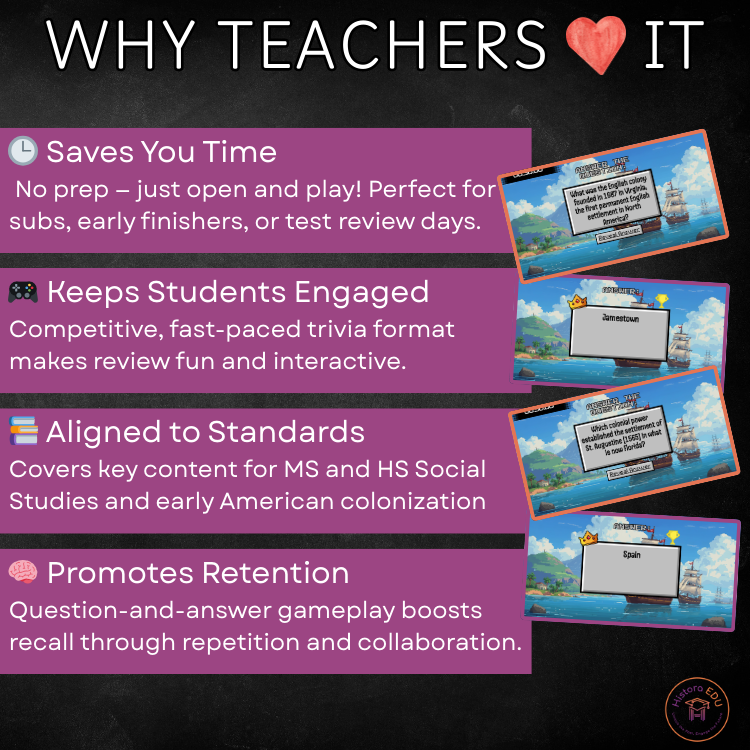
Inside the European Colonization Review Game
This European Colonization Review Game is designed to help students practice everything they need to know about Colonization in a fun, interactive format that keeps them talking, thinking, and learning.
The game covers:
- Why European nations colonized the Americas
- Differences among European powers
- Patterns of settlement and early colonial life
- Impacts on Indigenous peoples
- Economic systems like mercantilism and early trade networks
- Cultural, social, and political structures in early colonies
Every question reinforces essential content while revealing misconceptions that students might still have.
Along with the digital game, you’ll receive:
- A student-friendly play link
- A teacher version you can project
- Clear instructions
- An editable format you can customize to your own classroom
- A consistent structure that aligns with your other HistoraEDU review games
Whether you’re reviewing for a test, preparing for a quiz, or planning a sub day, this resource fits seamlessly into your Social Studies block.
👉 You can grab the European Colonization Review Game here on TPT.
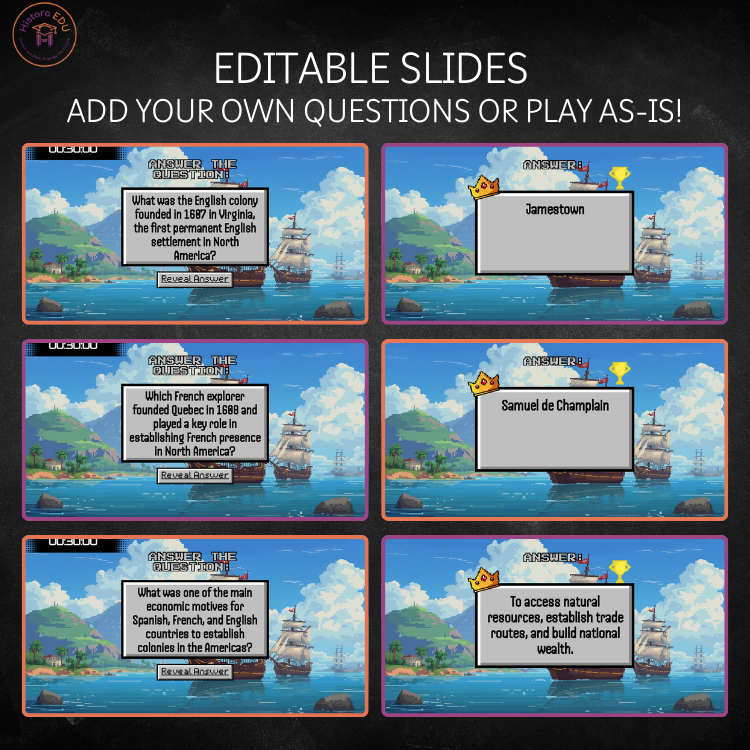
How to Use This European Colonization Review Game in Your Classroom
One of the reasons this game is such a teacher favorite is because it works beautifully in so many different instructional settings.
Whole-Class Competition
This is my go-to. Split students into teams, pass out whiteboards, and let the energy build. Students love competing for points, discussing answers, and trying to outsmart the other groups. It’s one of the few review activities that keeps every student locked in.
Stations or Centers
If you’re running a review day with multiple activities, this game is the perfect centerpiece. While one station handles mapping or reading tasks, another runs the game. Students rotate, staying active and engaged.
Partner or Small Group Play
For classes that benefit from peer discussion, small-group play is ideal. Students talk through questions, justify answers, and support one another’s learning.
Independent Play for Absent or Make-Up Work
Because the game includes a student link, learners who missed class can review at home or during intervention time.
Sub Plans That Actually Work
If you’ve ever left a packet for a sub and hoped for the best, you know the struggle. This game solves it: it’s self-contained, intuitive, and consistently effective — no busywork required.
Differentiation & Extension Ideas
This game is already accessible for diverse learners, but you can easily modify or extend it to maximize success.
Struggling learners can:
- Play with guided notes
- Work in pairs
- Pause between questions to review vocabulary or definitions
Advanced learners can:
- Explain why an answer is correct
- Compare colonization strategies
- Analyze long-term impacts and consequences
If you’d like to extend the activity into writing, try giving students a reflective question. Something like:
“Which European power had the most significant impact on the Americas? Explain your reasoning using evidence from the unit.”
This pushes students beyond recall into deeper historical thinking.
Where to Get the European Colonization Review Game (+ Bundle Options)
If you’re ready to make your European Colonization test prep more engaging and effective, you can find the full game here:
👉 European Colonization Review Game | Interactive Test Prep
If you teach 7th or 8th grade, or a full high school U.S. History course, this game is also part of two larger bundles designed to save you planning time and give you a complete, ready-to-teach review system for the entire year.
This bundle includes all the major review games for the first half of U.S. History, so you never have to scramble for test prep again — Indigenous America, Exploration, Colonization, 13 Colonies, American Revolution, Constitution, and more. It’s perfect if you want consistent, interactive, low-prep review days built right into your pacing.
If you’re ready to completely streamline your year, this bundle covers every unit from day one through the end-of-year final exam. Every review game follows the same structure, the same look, and the same ease-of-use — which means your students always know what to expect, and you always have a reliable test prep tool at your fingertips.
If you want a complete, consistent review system for the entire year — from Indigenous America all the way through Reconstruction — this bundle gives you everything you need.
Teachers love these bundles because they reduce prep time and give students a familiar, predictable format for test review across every unit.
⭐ Thanks for Teaching With HistoraEDU
I’m so glad you’re here. My goal with HistoraEDU is to help you bring history to life in ways that feel meaningful, engaging, and realistic for a busy classroom. If you want more teaching tips, new activities, and exclusive freebies straight to your inbox, join the HistoraEDU teacher community below. You’ll get access to my Teacher Toolkit, early product releases, classroom-tested strategies, and seasonal freebies sent right to your inbox.
📬 Join the HistoraEDU Email List
Where history teachers get smarter strategies — not more work.
Whether you’re here for engaging lessons, low-prep review games, or just a spark of inspiration on a long Tuesday afternoon, I’m glad you’re part of this community. More resources, classroom stories, and ready-to-teach materials are on the way — and I can’t wait to share them with you!
Happy teaching,
Sarah @ HistoraEDU


