
If you’ve ever wrapped up your European Exploration unit only to discover your students still mixing up explorers, trade routes, motives, and global impacts… welcome to the club. This unit is fascinating, but it’s also dense. And when test prep rolls around, students suddenly can’t remember whether Magellan was the one who circumnavigated the globe, whether Columbus went to Asia or the Americas, or what “Gold, God, and Glory” actually meant.
I’ve taught the Age of Exploration for years, and no matter how engaging the lessons are, review time always used to feel overwhelming — for both me and my students. That’s why I created this European Exploration Review Game: a low-prep, interactive way for students to revisit key explorers, motives, technologies, and impacts in a way that’s memorable and actually fun.
If your test prep needs a boost, or you’re just tired of the same old study guide routine, this game will become one of your favorite tools too. Let’s dive into why reviewing European Exploration is tough for middle schoolers and how this game can transform your review day.

Why Reviewing European Exploration Can Be Tough for Students
European Exploration is one of those topics that seems straightforward on the surface — explorers sailed, they reached new places, the world became more connected — but it’s actually far more nuanced, which makes review tricky.
Students get tangled up in explorers’ names, routes, and contributions. They mix up who sailed for which country. They forget the difference between exploration and colonization. And don’t even get me started on motives. I’ve seen “Gold, God, Glory” reinvented into “Gold, Glory, Grapes” more than once.
The content is fascinating, but when students are sitting with their notes trying to make sense of it all, it suddenly feels like a giant historical word jumble.
Traditional review methods don’t always help. Worksheets feel repetitive. Packets become overwhelming. Reading notes doesn’t build confidence — it usually just triggers mild panic.
I wanted something that would let students interact with the material rather than stare blankly at a page. That’s why an interactive review game was the perfect solution. Reviewing shouldn’t feel like punishment — it should feel like an extension of learning.
What Students Really Need to Know About European Exploration (AKA the Age of Discovery)
Before students take their assessment, there are a few core ideas they need to truly grasp — not just memorize.
First, students need to understand why Europeans started exploring in the first place. The motives of Gold, God, and Glory shaped nearly every voyage during the Age of Discovery. They weren’t sailing just because they felt adventurous — they wanted faster trade routes, wealth, land, religious influence, and national power.
Then there’s the role of technology. Students often forget that exploration wasn’t possible before innovations like new maps, compasses, caravels, and improved navigation techniques. These advancements made long-distance ocean travel both possible and profitable.
Students also need clarity on major explorers and their achievements. Who went where? Who circumnavigated the globe? Who founded what? Who “discovered” (or more accurately, encountered) what regions? These details come up in almost every exploration test, but they’re also the details students mix up the most.
Another major component is understanding the global impact of exploration — new trade routes, cultural interaction, and the early beginnings of global exchange networks. Students should know that the Age of Exploration set off massive changes, good and bad, that shaped the modern world.
And of course, there are the inevitable misconceptions. Many students assume all explorers sailed west. Some believe the Age of Exploration happened in a matter of years rather than centuries. Others confuse it with colonization or assume Indigenous peoples were passive bystanders. These misunderstandings need to be addressed directly — and review time is the perfect opportunity.
That’s why I love using interactive activities: they help students see what they think they know, and correct themselves quickly.
Why Review Games Work So Well for Test Prep
Middle schoolers don’t want another worksheet. They want movement, competition, collaboration — something to spark their brains and keep them engaged. Review games check every box.
One of the best things about using a trivia-style review game is that it forces students into active recall. Instead of looking at notes and hoping something sticks, they have to retrieve information from memory. That act of retrieval strengthens learning more than any study sheet ever could.
It also creates a sense of excitement around review. When students can debate answers, challenge their teammates, or even race another group, they’re suddenly invested in material they weren’t so sure about five minutes earlier. I’ve watched students cheer for getting an explorers question correct. I’ve also watched them sigh dramatically when they mix up Vespucci and Cabot. Either way — they’re learning.
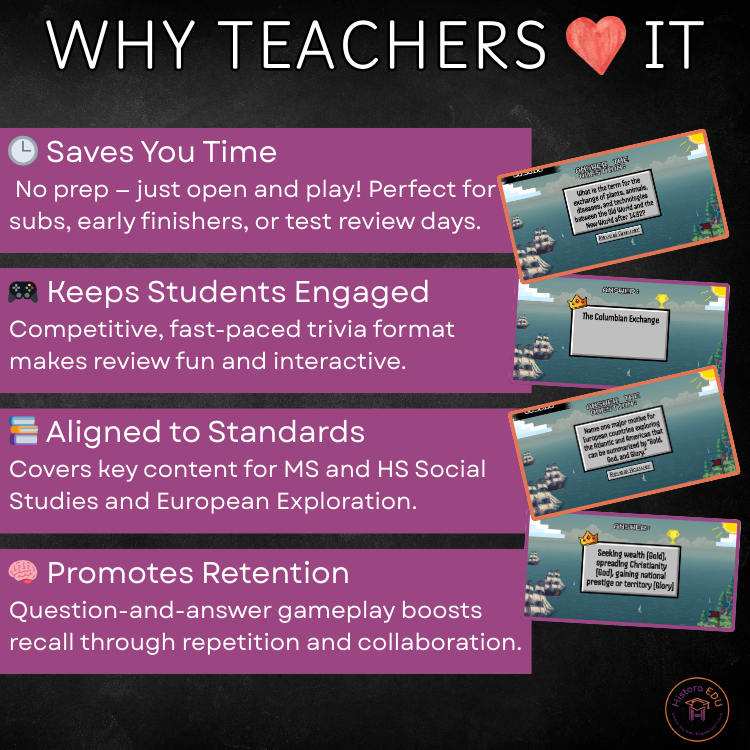
And for teachers? It’s low-prep, high-impact. You don’t need to prep materials or lecture through content again. Just open the game, project it, or link it to student devices. You get to walk around, monitor misconceptions, support small groups, and actually enjoy the review process.
Inside the European Exploration Review Game
This review game covers all the major concepts you want students to understand before taking their test. Students revisit explorers, motives, technology, trade routes, early encounters, and global impact — all through 50+ classroom-ready questions.
You don’t just get a game, though. You get:
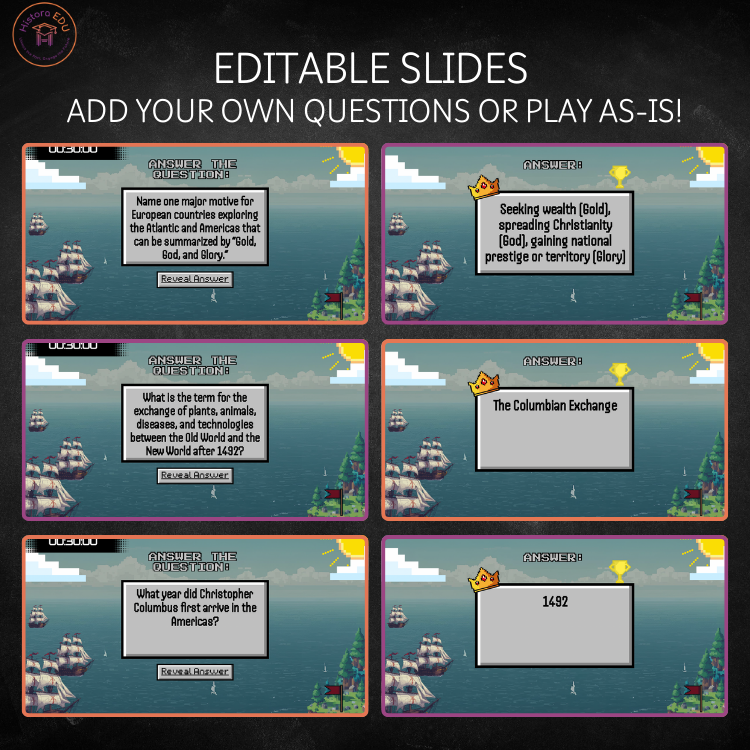
- A fully interactive digital version
- A student-ready gameplay link for easy sharing
- A customizable, editable template
- Clear teacher instructions
- A resource that works for grades 6–8 (and even 9–10 as a refresher)
- A tool that fits in a 20–40 minute class period
Whether you teach world history or early U.S. history, it fits seamlessly into your curriculum.
If you want to take a closer look or start using it in your classroom, you can find it here:
👉 European Exploration Review Game | Age of Exploration Trivia & Test Prep
How to Use This Game in Your Classroom
There are so many ways to bring this game into your teaching, and every teacher I know finds a different favorite method.
One of mine is whole-class competition. I divide students into teams and give each group a whiteboard. The room gets loud — in the best possible way. Students debate answers, cheer each other on, and surprise themselves with how much they really know.
Another option is using the game in stations. While one group is reviewing explorers with the game, another group might be mapping exploration routes or analyzing short primary sources. This works especially well in classes with mixed readiness levels, because each student engages with material in a way that fits their learning style.
For small groups or independent practice, the game is equally powerful. Students who missed class or need extra reinforcement can work at their own pace and get instant feedback.
And yes — this makes an excellent sub plan. Seriously. Leave the link, give simple directions, and your students get meaningful review even in your absence. It’s a lifesaver for busy weeks.
If you need something that works in multiple contexts — test prep, early finishers, sub days, small groups — this review game does the job beautifully.
Differentiation & Extension Ideas
One of the biggest benefits of review games is how adaptable they are.
If you have students who need extra support, let them reference notes during the first few rounds. Or pair them with a stronger partner. If you have students who need enrichment, challenge them to explain why the correct answer is right or ask them to predict the global impacts of a discovery.
You can also turn individual questions into exit tickets or bell ringers. I’ve used some of these questions during warm-ups for days leading up to the test, and it helps reinforce content in bite-sized pieces.
If you’d like to extend into writing, try this reflection prompt:
“Choose one explorer from the game and explain how their journey changed the world. What motivated them, and what were the short- and long-term impacts of their expedition?”
Prompts like this help build historical reasoning skills while strengthening content knowledge.
Where to Get the European Exploration Review Game (+ Time-Saving Bundles)
If you’re ready to bring this interactive review activity to your classroom, you can grab it here:
👉 European Exploration Review Game | Age of Exploration Trivia & Test Prep
If you teach 7th or 8th grade U.S. History, this game is also part of two larger bundles designed to save you planning time and give you a complete, ready-to-teach review system for the entire year.
This bundle includes all the major review games for the first half of U.S. History, so you never have to scramble for test prep again — Indigenous America, Exploration, Colonization, 13 Colonies, American Revolution, Constitution, and more. It’s perfect if you want consistent, interactive, low-prep review days built right into your pacing.
If you’re ready to completely streamline your year, this bundle covers every unit from day one through the end-of-year final exam. Every review game follows the same structure, the same look, and the same ease-of-use — which means your students always know what to expect, and you always have a reliable test prep tool at your fingertips.
If you want a complete test prep system for the entire school year, this bundle is your best value. It includes every review game from Indigenous America all the way to Reconstruction, designed to streamline assessments and make review days stress-free.
Teachers love these bundles because they always know exactly how they’ll review each unit — no scrambling, no extra prep, just high-quality interactive games ready to use.
⭐ Thanks for Teaching History With HistoraEDU
I’m so glad you’re here. My goal with HistoraEDU is to help you bring history to life in ways that feel meaningful, engaging, and realistic for a busy classroom. If you want more teaching tips, new activities, and exclusive freebies straight to your inbox, join the HistoraEDU teacher community below. You’ll get access to my Teacher Toolkit, early product releases, classroom-tested strategies, and seasonal freebies sent right to your inbox.
📬 Join the HistoraEDU Email List
Where history teachers get smarter strategies — not more work.
Whether you’re here for engaging lessons, low-prep review games, or just a spark of inspiration on a long Tuesday afternoon, I’m glad you’re part of this community. More resources, classroom stories, and ready-to-teach materials are on the way — and I can’t wait to share them with you!
Happy teaching,
Sarah @ HistoraEDU


