
If you’ve ever finished your 13 Colonies unit feeling confident — only to find your students mixing up New England and Southern characteristics, confusing founding dates, or insisting Jamestown was in Massachusetts — then welcome to the reality of teaching Colonial America. The content is rich and fascinating, but it’s also full of details that middle schoolers tend to blend together the moment you say “review day.”
I’ve watched students stare down their study guides with that familiar “I’ve never seen this before in my life” look, even though we spent weeks exploring regional differences, economics, daily life, and colonial motivations. And who could blame them? It’s a lot to hold in working memory, especially when the differences between colonies can feel subtle without repeated, meaningful practice.
That’s exactly why I created the 13 Colonies Review Game — a fun, interactive way for students to revisit and truly retain the major concepts of Colonial America. It’s the test prep activity that transformed my review days from quiet worksheets into energetic, engaged learning.
Let’s break down exactly why the 13 Colonies can be tricky to review, what students really need to understand, and how this review game can make your next test prep session smoother, stronger, and a whole lot more enjoyable.

Why 13 Colonies Test Prep Feels Difficult for Students
The 13 Colonies unit is one of the most foundational parts of early U.S. History, but it also comes with a surprising number of challenges. Students are expected to remember:
- Which colonies belonged to which region
- Why each colony was founded
- The differences in economy, geography, religion, and culture
- How people lived day-to-day
- The early relationship between colonists and Indigenous peoples
That’s a lot of information for middle school brains to juggle — especially when so many names, maps, and concepts overlap.
One of the biggest issues I see is that students often think all colonial regions are basically the same. They know the words “New England,” “Middle Colonies,” and “Southern Colonies,” but they forget what actually set them apart. Without active review, those regional distinctions start to blur.
And then there’s the problem of memorizing founders or motivations. Students often remember one or two stories but forget the nuance — like why the Puritans left England, why Georgia was founded as a buffer colony, or how the Middle Colonies became a cultural melting pot.
Traditional review methods don’t always help. Study guides, worksheets, and note rereads feel dry. Students go through the motions without really engaging in the kind of thinking that test prep requires.
That’s where interactive review makes all the difference.
What Students Really Need to Understand About the 13 Colonies
Before students take a Colonial America test, they need a solid foundation in the major themes of the unit — not just surface-level memorization. The goal is to help them understand how the colonies grew, why they were different, and how those differences shaped early American society.
One of the most important concepts is the idea of regional diversity. The New England Colonies were shaped by rocky soil, a coastal economy, and a religious community structure. The Middle Colonies thrived economically because of fertile land, trade ports, and diverse cultures. The Southern Colonies centered around plantation agriculture, enslaved labor, and long growing seasons. When students see these patterns clearly, everything else starts to make sense.
Another essential piece is understanding why colonists came to America in the first place. Some groups came seeking religious freedom. Others came in search of land, wealth, or fresh starts. Students often think “everyone came for freedom,” but the truth is far more nuanced — and helping them unpack those motives improves comprehension and test performance.
Students also need a realistic picture of economics and daily life in each region. What you grew, built, traded, ate, and believed depended heavily on where you lived. Without understanding how geography shaped life, students struggle to make meaningful comparisons.
And finally, students need to understand the early interactions between colonists and Indigenous peoples. Many assessments include questions about cooperation, conflict, land use, and cultural misunderstandings.
When students don’t get repeated opportunities to practice retrieving this information, they forget it. That’s why active review strategies — especially review games — are essential.
Why Review Games Are a Game-Changer for Colonial America Test Prep
Middle schoolers love competition. They love challenges. And more than anything, they love feeling successful. Review games hit all three of those sweet spots in a way that worksheets never can.
When I switched to review games, I immediately saw a difference in how my students approached test prep. Instead of passively rereading notes, they were on their feet, talking to each other, debating answers, cheering when they got questions right, and — yes — actually remembering the content.
A review game turns test prep into a memorable experience. It takes what students already know, tests it, stretches it, and reinforces it — all while building their confidence.
Games also encourage active recall, one of the most effective strategies for long-term retention. Students aren’t reading; they’re retrieving. They’re thinking, questioning, and self-correcting. They’re learning.
And for teachers? Review games are a breath of fresh air. You get to step back, guide the flow, and observe misconceptions as they appear. You don’t have to lecture or create tons of prep materials. The game does the heavy lifting — and the room stays alive.
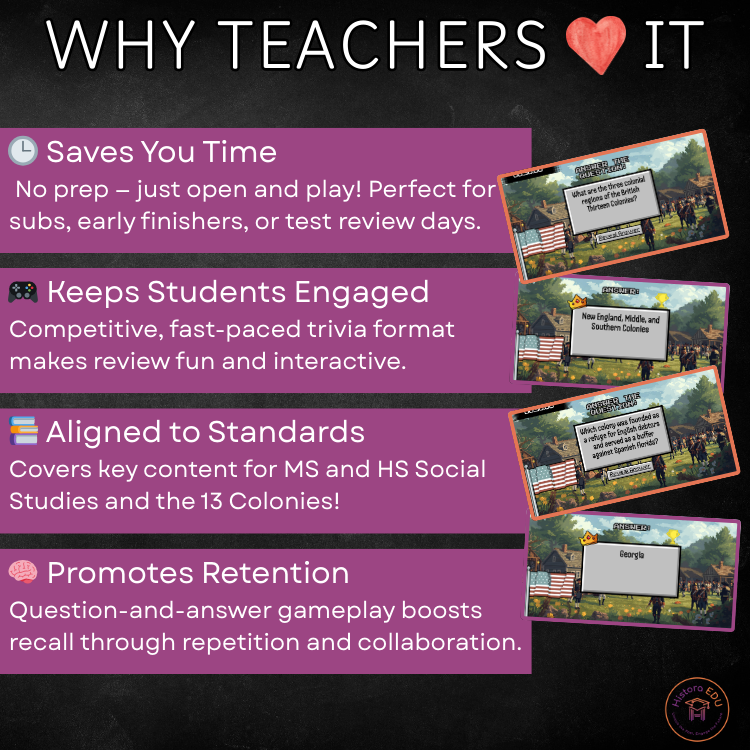
Inside the 13 Colonies Review Game
This 13 Colonies Review Game is designed to help students review all the most essential Colonial America content — without zoning out, feeling overwhelmed, or checking out before the test.
Inside this interactive game, students revisit:
- The three colonial regions and what made each distinct
- The founding of major colonies
- Economic systems and trade patterns
- Cultural and religious differences
- Daily life and early colonial society
- Interactions between colonists and Indigenous peoples
Every question is standards-aligned and classroom-tested.
You’ll also receive:
- A fully interactive digital game
- A student-ready link you can drop into Google Classroom
- Clear teacher instructions
- An editable version so you can add or adjust content
- A resource that works beautifully for grades 6–8 (and even 9–10 review)
Most importantly, this resource is genuinely effective. It helps students spot gaps in their understanding and correct them in real time — a crucial step before any assessment.
👉 You can grab the 13 Colonies Review Game on TPT here
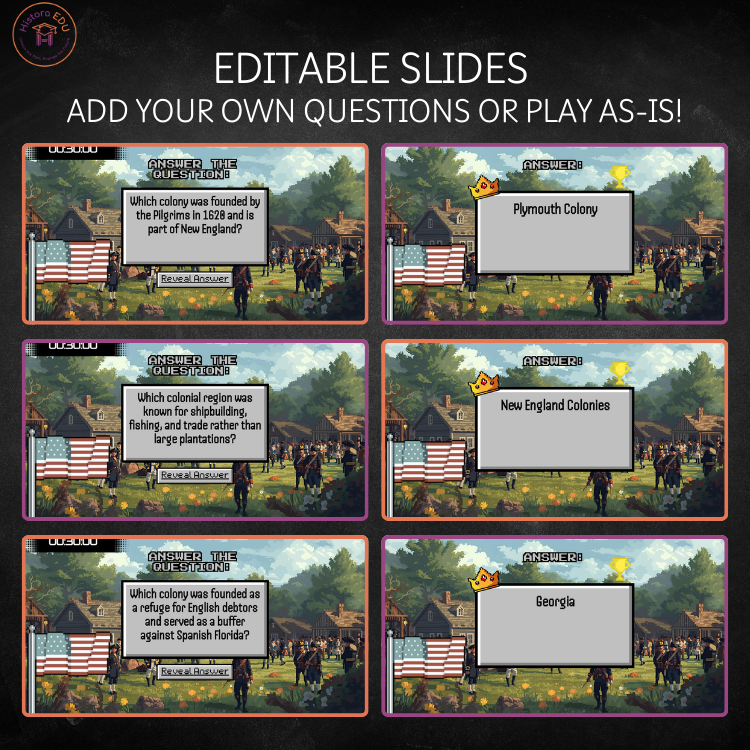
How to Use This 13 Colonies Review Game in Your Classroom
One of the best things about interactive review games is that they work in so many different formats. Whether you have a 20-minute gap, a full review day, or a sub plan emergency, this game fits.
Whole-Class Game Day
This is the most high-energy way to use the game. Divide students into teams, hand out whiteboards, and let the friendly competition begin. The room fills with excitement — and suddenly even your quietest students have opinions about whether the Middle Colonies really were the “breadbasket.”
Stations or Rotations
This is ideal for classrooms that benefit from movement or differentiation. One station can use the game. Another can review maps. Another can examine primary sources or analyze founding documents. The variety keeps engagement high and helps reach all learners.
Partner or Small-Group Work
Some students learn best through discussion. Others benefit from the support of a peer. The game works beautifully in small groups, especially when you want to reteach or reinforce specific concepts.
Sub Plans & Early Finishers
This might be my favorite use. Sub plans can be notoriously hard to prepare, but review games solve that problem instantly. Just leave the link and simple instructions. Students stay on task, and subs appreciate having a structured, engaging activity ready to go.
If your test prep feels repetitive or your students lose steam, this game will bring the energy back.
Differentiation & Extension Ideas
Good review doesn’t look the same for every student. This game gives you flexibility to meet your learners where they are.
If you have students who need more support, you can let them use guided notes during the first round or pair them with strong partners. If you want to challenge students who are ready for deeper thinking, ask them to justify answers or compare two colonial regions using evidence from the game.
You can even turn questions into short written responses. One of my favorite extensions is asking students to write:
“Which colonial region would you want to live in and why?”
This not only reinforces content but pushes students to think critically about the cultural and economic realities of colonial life.
Where to Get the 13 Colonies Review Game (+ Time-Saving Bundles)
If you’re ready to bring interactive Colonial America test prep into your classroom, you can grab the full resource here:
👉 13 Colonies Review Game | Interactive Test Prep: English Colonies
If you teach 7th or 8th grade, or a full high school U.S. History course, this game is also part of two larger bundles designed to save you planning time and give you a complete, ready-to-teach review system for the entire year.
This bundle includes all the major review games for the first half of U.S. History, so you never have to scramble for test prep again — Indigenous America, Exploration, Colonization, 13 Colonies, American Revolution, Constitution, and more. It’s perfect if you want consistent, interactive, low-prep review days built right into your pacing.
If you’re ready to completely streamline your year, this bundle covers every unit from day one through the end-of-year final exam. Every review game follows the same structure, the same look, and the same ease-of-use — which means your students always know what to expect, and you always have a reliable test prep tool at your fingertips.
If you want a complete, consistent review system for the entire year — from Indigenous America all the way through Reconstruction — this bundle gives you everything you need.
Teachers love these bundles because they reduce prep time and give students a familiar, predictable format for test review across every unit.
⭐ Thanks for Teaching With HistoraEDU
I’m so glad you’re here. My goal with HistoraEDU is to help you bring history to life in ways that feel meaningful, engaging, and realistic for a busy classroom. If you want more teaching tips, new activities, and exclusive freebies straight to your inbox, join the HistoraEDU teacher community below. You’ll get access to my Teacher Toolkit, early product releases, classroom-tested strategies, and seasonal freebies sent right to your inbox.
📬 Join the HistoraEDU Email List
Where history teachers get smarter strategies — not more work.
Whether you’re here for engaging lessons, low-prep review games, or just a spark of inspiration on a long Tuesday afternoon, I’m glad you’re part of this community. More resources, classroom stories, and ready-to-teach materials are on the way — and I can’t wait to share them with you!
Happy teaching,
Sarah @ HistoraEDU


