
Teaching the American Revolution is one of those magical moments in the school year when students feel genuinely invested. The debates, the protests, the “no taxation without representation,” the midnight rides — it all feels exciting and cinematic. Students latch onto the stories, the heroes, the turning points.
But when test prep rolls around?
Suddenly, your once-confident students are mixing up their battles, confusing their founding documents, blending timelines, and insisting the Declaration of Independence was signed after Yorktown. They can explain the Boston Tea Party in vivid detail… but forget what made the Battle of Saratoga a turning point.
The American Revolution is an exciting unit — but it’s also dense, layered, and packed with names, causes, effects, and events that can feel overwhelming during review.
That’s exactly why I created this American Revolution Review Game: to make test prep meaningful, interactive, and — dare I say — actually fun. This game takes the best parts of the Revolutionary War unit and turns them into a lively, memorable learning experience that helps students recall what they’ve learned with confidence.
Let’s walk through why this unit is tough to review, what students truly need to understand, and how an interactive review game can completely transform your classroom’s test prep day.

Why Reviewing the American Revolution Is So Challenging
The American Revolution unit is full of powerful ideas and compelling stories. That’s part of its appeal — and also part of the challenge.
Students are expected to grasp:
- The long-term causes that built tension over time
- A chronological sequence of events (and there are a lot of them)
- The meaning and impact of foundational documents
- The contributions of numerous historical figures
- Both the hardships and triumphs of the Continental Army
- The outcome and what it meant for the formation of a new nation
That’s a massive cognitive load for middle schoolers.
And here’s what typically happens during review:
Students mix up causes and effects.
They know the colonists were angry about taxes, but they confuse which tax led to what protest… and why.
Timelines fall apart.
Lexington and Concord? Saratoga? Yorktown? Students remember the stories but not the order.
They overgeneralize the conflict.
Many believe “everyone wanted independence,” ignoring the role of Loyalists and undecided colonists.
Documents get muddy.
They recall that the Declaration of Independence is important but forget its purpose, structure, or key ideas.
Review packets and study guides rarely fix these misunderstandings. Students skim, guess, or freeze. They need something better — something that helps them think rather than copy.
That’s where review games shine.
What Students Really Need to Know About the American Revolution
Before students sit down for their Revolutionary War test, they need a strong foundation in the major themes, ideas, and events of the unit — not just memorized facts.
The Causes of the Revolution
Students should understand why the colonists rebelled:
- Taxation without representation
- The Intolerable Acts
- Widening tension between colonial self-government and British control
These weren’t sudden issues — they were the result of decades of friction.
The Timeline of Key Events
Understanding the order is essential:
- Lexington & Concord ignited the war
- Bunker Hill tested colonial resolve
- Saratoga shifted global alliances
- Yorktown brought the war to an end
Students often recall these individually but forget how they connect.
Foundational Documents
The Declaration of Independence is a cornerstone of the unit. Students must understand:
- Its purpose
- Its arguments
- Its long-term influence
It’s more than a symbol — it’s a political and philosophical statement.
Key People
George Washington, Samuel Adams, Abigail Adams, King George III, Benjamin Franklin, Marquis de Lafayette… the list goes on. Students should know who they were and why they mattered.
The Outcome and Its Impact
The Treaty of Paris, the rise of a new nation, and long-term global effects belong in every strong review.
This is a lot of information — and students need repeated, active retrieval to make it stick.
Why Review Games Work So Well for This Unit
Middle schoolers learn best when they’re active participants. Review games turn test prep from a passive task into an engaging experience that builds confidence and strengthens recall.
When I introduced interactive review games into my American Revolution unit, something shifted. Students who were usually quiet suddenly had opinions about the turning points of the war. Kids who struggled with timelines were talking through answers with their teams. The room felt alive. And the scores? They improved — significantly.
Here’s why review games work:
They promote active recall
Students aren’t just reading information; they’re producing it from memory, which is a proven strategy for long-term retention.
They build confidence
Students get to practice in a low-stakes environment. Mistakes become learning moments rather than stress triggers.
They encourage collaboration
When students discuss, debate, and justify their answers, they deepen their understanding.
They’re low prep for teachers
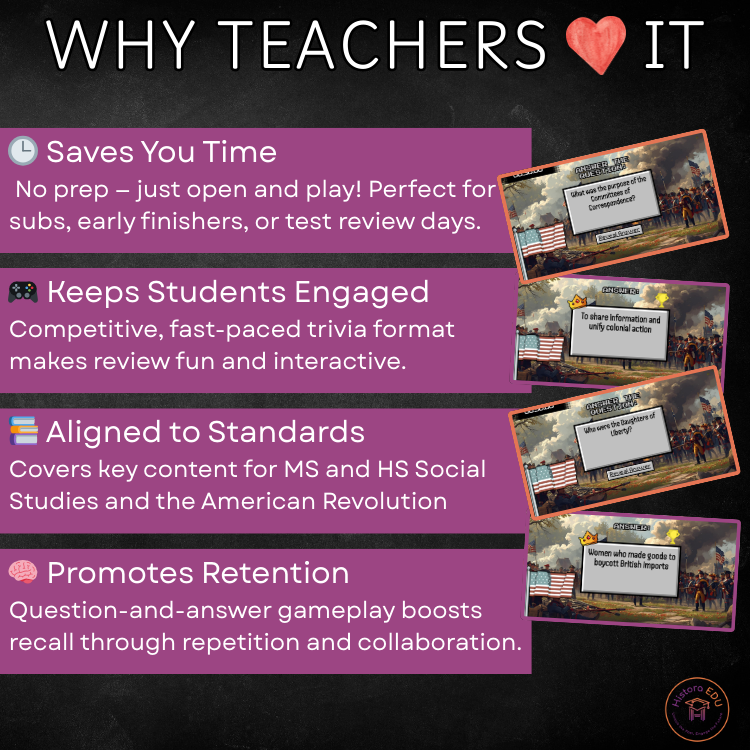
Once you open the game, your work is basically done. No hours spent assembling packets or reteaching everything.
They’re engaging
Even students who typically disengage during Social Studies find themselves wanting to participate — because it feels like a challenge, not a chore.
This is the review strategy that has consistently transformed my classroom energy.
Inside the American Revolution Review Game
This American Revolution Review Game is designed to help students practice the most essential Revolutionary War content in a format that is fast-paced, lively, and memorable.
Students review:
- Major causes of the Revolution
- Key battles and turning points
- Influential people on both sides of the conflict
- Important documents, including the Declaration
- Effects of the war and the Treaty of Paris
The questions are clear, accurate, and aligned to common middle school standards.
Teachers receive:
- A fully interactive digital game
- A student-friendly link for instant access
- Teacher instructions and timing suggestions
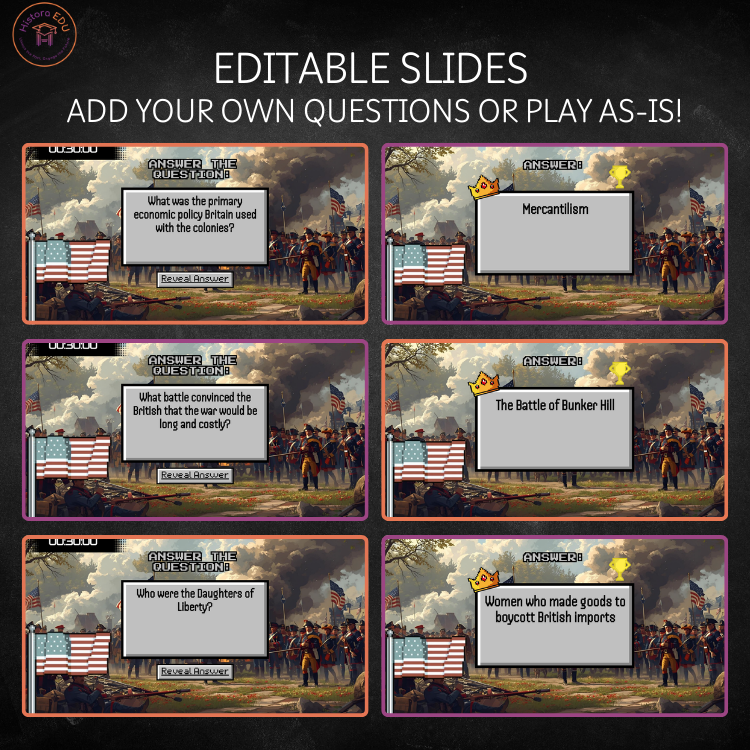
- An editable version for customization
- A resource perfectly suited for grades 6–8
Whether you’re preparing students for a unit test or giving them one final refresher before state assessments, this review game delivers.
👉 Grab the American Revolution Review Game here on Teachers Pay Teachers
How to Use This Game in Your Classroom
One of the best things about this review game is how flexible it is. No matter your class size, schedule, or student needs, it fits.
Whole-Class Review Game
This format brings the most excitement. Students break into teams, grab whiteboards, and compete for points. The friendly competition keeps everyone engaged — and even reluctant learners find themselves participating.
Stations or Rotations
If you prefer a more structured environment, the review game works beautifully as one station in a rotation. While one group plays the game, others can work on maps, timelines, or document analysis.
Small Group or Partner Play
Some students perform better in smaller settings. Small groups allow students to talk through every answer, which reinforces understanding.
Independent Review for Absences
If a student misses a day or needs to make up learning time, the student link gives them a meaningful review activity they can use independently.
Sub Plans
This might be my favorite use-case. The game is intuitive, engaging, and requires no complicated instructions. Subs appreciate it, and students stay meaningfully occupied.
Differentiation & Extension Ideas
You can adapt this game to support all learners in your classroom.
For students who need extra support:
- Let them use guided notes for the first round
- Pair them with a strong partner
- Pause after each question to build discussion
For students who need enrichment:
- Ask them to explain why their answer is correct
- Have them analyze how a cause led to an effect
- Encourage them to compare key figures or battle strategies
You can even add a writing extension:
“Why was the Battle of Saratoga considered the turning point of the American Revolution? Provide evidence from the unit.”
This adds depth and helps students prepare for short-answer assessments.
Where to Get the American Revolution Review Game (+ Bundles That Save Time)
If you’re ready to bring more engagement to your American Revolution test prep, you can grab the full game here:
👉 American Revolution Review Game | Interactive Test Prep & Trivia
This resource is also included in two time-saving bundles:
If you teach 7th or 8th grade, or a full high school U.S. History course, this game is also part of two larger bundles designed to save you planning time and give you a complete, ready-to-teach review system for the entire year.
This bundle includes all the major review games for the first half of U.S. History, so you never have to scramble for test prep again — Indigenous America, Exploration, Colonization, 13 Colonies, American Revolution, Constitution, and more. It’s perfect if you want consistent, interactive, low-prep review days built right into your pacing.
If you’re ready to completely streamline your year, this bundle covers every unit from day one through the end-of-year final exam. Every review game follows the same structure, the same look, and the same ease-of-use — which means your students always know what to expect, and you always have a reliable test prep tool at your fingertips.
If you want a complete, consistent review system for the entire year — from Indigenous America all the way through Reconstruction — this bundle gives you everything you need.
Teachers love these bundles because they reduce prep time and give students a familiar, predictable format for test review across every unit.
⭐ Thanks for Teaching With HistoraEDU
I’m so glad you’re here. My goal with HistoraEDU is to help you bring history to life in ways that feel meaningful, engaging, and realistic for a busy classroom. If you want more teaching tips, new activities, and exclusive freebies straight to your inbox, join the HistoraEDU teacher community below. You’ll get access to my Teacher Toolkit, early product releases, classroom-tested strategies, and seasonal freebies sent right to your inbox.
📬 Join the HistoraEDU Email List
Where history teachers get smarter strategies — not more work.
Whether you’re here for engaging lessons, low-prep review games, or just a spark of inspiration on a long Tuesday afternoon, I’m glad you’re part of this community. More resources, classroom stories, and ready-to-teach materials are on the way — and I can’t wait to share them with you!
Happy teaching,
Sarah @ HistoraEDU


