
If you’ve ever tried to review the U.S. Constitution with your middle schoolers and ended up hearing things like, “Wait… the president MAKES laws, right?” or “Why do we even have three branches?” — trust me, you are not alone. The Constitution unit is one of those topics students find interesting in theory but confusing in practice. They want to understand how the government works, but once you bring up checks and balances or the Bill of Rights, their eyes glaze over faster than you can say “Article I.”
It’s not their fault. The U.S. Government & Constitution unit is full of abstract ideas, new vocabulary, and real-world applications that feel far removed from their daily lives. By the time test prep rolls around, even your strongest students may start mixing up branches, amendments, and processes they swear they understood last week.
That’s exactly why I created this U.S. Government & Constitution review game. I needed a way to help my students make sense of civics without turning the entire week into lecture part two. I wanted something active, meaningful, and engaging — something that didn’t make me carry the weight of reteaching everything, and didn’t make them feel like they were drowning in flashcards.
This game became the tool that finally brought everything together for my students — and made Constitution test prep smoother, clearer, and honestly… fun.
Let’s walk through why this unit can be so tricky, what students actually need to master, and how an interactive review game can completely change the energy of your civics classroom.

Why Constitution Test Prep Feels So Hard for Middle Schoolers
I used to think the hardest part of teaching the Constitution was helping students memorize the three branches. But it turns out the real challenge is helping them understand how everything connects. They mix up powers constantly (“Congress appoints judges, right?”), they confuse amendments with articles, and they think federalism is just “a fancy word teachers like to say.”
The Constitution is foundational — but it’s also layered. Students need to grasp:
- How the government is structured
- Why power is divided
- What checks and balances actually look like
- What the Bill of Rights protects
- How a law becomes a law
That’s a lot of abstract thinking for middle schoolers who are still trying to remember if judicial means “judge-y” or “jury-ish.”
And to be fair… civics is hard! The concepts are huge. The vocabulary feels new. And the whole system can feel like a puzzle made of invisible pieces.
Traditional review didn’t help my students at all. Worksheets bored them. Study guides frustrated them. Reading notes again? They might as well have been reading ancient Greek.
Which is exactly why I knew they needed something more active — something that would let them test their understanding, talk through ideas, and see where their misconceptions were hiding.
Enter: the review game.
What Students Need to Know About U.S. Government & the Constitution
Before students can feel confident walking into a Constitution test, they need a clear understanding of the big ideas — not just memorized definitions.
I like to frame the Constitution as the “instruction manual” for the United States. It tells us:
- How the government works
- What each branch can and cannot do
- How power is balanced
- What rights the people have
- How the system adapts over time
When you present it this way, everything becomes a little more approachable.
Students need to understand that Article I isn’t random, and the Bill of Rights isn’t just a list of rules. Everything plays a role in shaping how we live today.
But misconceptions still pop up constantly:
- Students assume the president can do everything.
- They think the Supreme Court can remove members of Congress.
- They mix up individual rights (“freedom of speech means I can say ANYTHING”).
- They think amendments were added all at once.
And honestly? These misunderstandings don’t magically disappear with one more lecture.
Students need practice. They need retrieval. They need to interact with the content in a way that forces them to think — without overwhelming them.
That’s why review games are such an effective tool.
Why Review Games Work So Well for Civics
Middle schoolers love debate. They love competition. They love feeling successful. And they learn best when they’re actively doing something — not just sitting and listening.
A review game turns civics into an interactive challenge instead of a passive review.
Students aren’t just staring at notes. They’re recalling information. They’re discussing questions. They’re spotting misunderstandings. They’re gaining confidence. And they’re actually enjoying themselves.
While playing this Constitution review game, I hear things like:
- “No, wait — that’s a legislative power!”
- “Checks and balances means the president can’t do that!”
- “Is that First Amendment or Fourth Amendment? Think!”
- “Ohhhh, I get it now!”
Music to any Social Studies teacher’s ears.
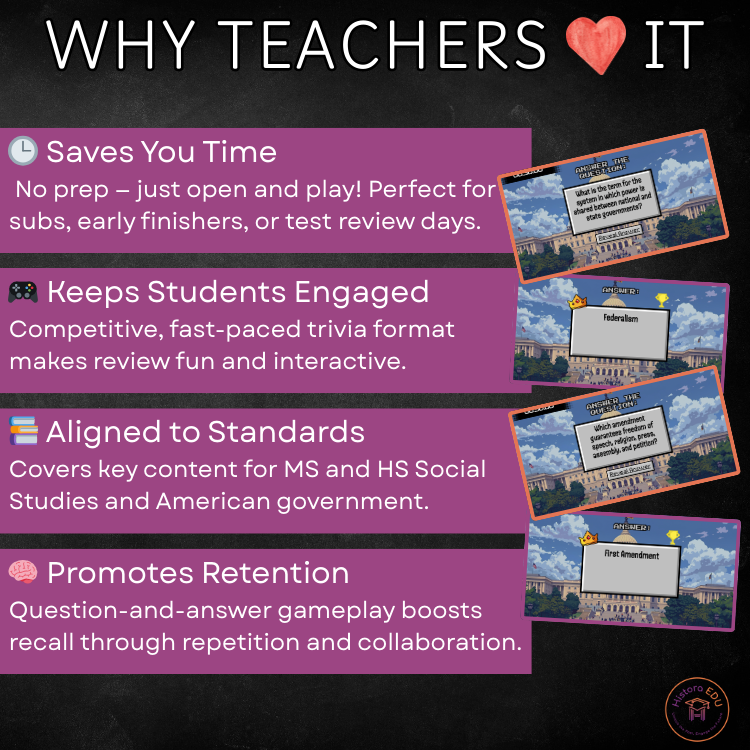
For teachers, the game is low prep and incredibly flexible. Whether you’re running it whole-class, in stations, in pairs, or as a sub plan, it fits seamlessly into your schedule. It transforms review from a slog into something students look forward to.
This game — more than anything else I’ve tried — consistently helps my students walk into their Constitution test feeling prepared, confident, and actually proud of what they’ve learned.
Inside the U.S. Government & Constitution Review Game
This review game covers all the major concepts students need to know for a middle school Constitution test — without overwhelming them.
Students review:
- The three branches of government
- Checks and balances with real examples
- Separation of powers
- The Bill of Rights and major amendments
- How a bill becomes a law
- Federalism and shared powers
- The structure and purpose of the Constitution
Teachers receive:
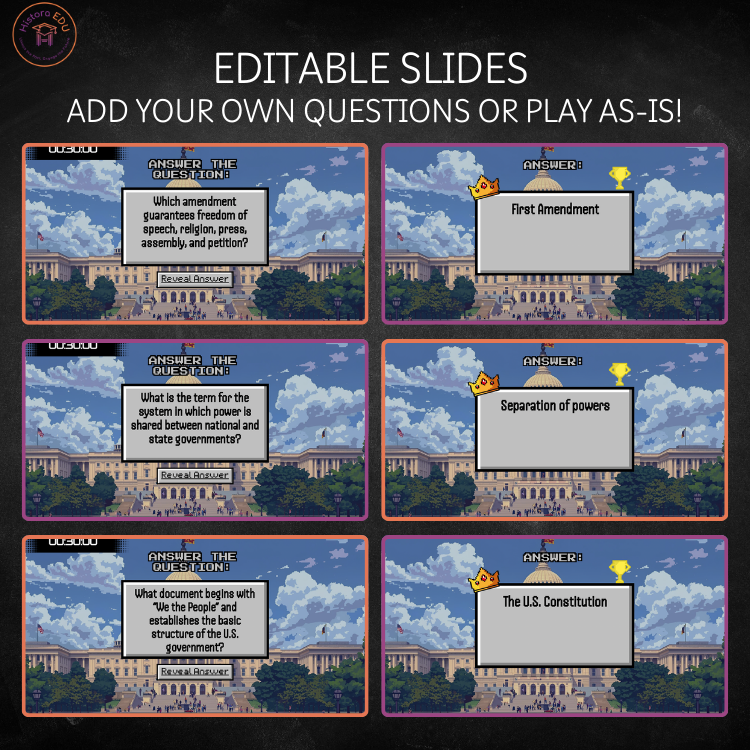
- A fully interactive digital version of the review game
- A student-ready link for independent or small-group play
- An editable version for customization
- Clear teacher instructions for pacing and setup
Whether you teach 6th, 7th, or 8th grade social studies, this resource fits perfectly — and it can even be used as a quick refresher in high school civics courses.
The game is easy to run. You can project it for whole-class play, use it in station rotations, or let students play in groups. I’ve used it in short 20-minute review blocks and full 40-minute class periods — it’s flexible enough for whatever time you have.
How to Use This Constitution Review Game in Your Classroom
One of the things teachers love most about this game is how seamlessly it fits into different teaching styles.
On whole-class game days, I split students into teams, hand out whiteboards, and let them debate the answers. The energy shifts instantly. Suddenly, students who never raise their hands are confidently arguing about which branch has which power — and they’re right.
When I want to differentiate, I use the game as part of a station rotation. While one group analyzes a political cartoon or reads an excerpt from the Bill of Rights, another group works through the review game. It adds activity and movement to a unit that can otherwise feel very vocabulary-heavy.
This game also works beautifully for small-group intervention. Students who have trouble grasping civics concepts benefit from the discussion and repetition the game naturally provides.
If you’re ever out unexpectedly, this is also a fantastic sub plan. You leave the link, the class plays, and they get real, meaningful review instead of busywork.
No matter how you use it, the game adapts to your classroom needs — which is why it quickly becomes a staple during test prep season.
Differentiation & Support Ideas
Review games naturally create space for supporting all learners, but you can adapt this one even further.
For learners who need extra structure:
- Let them use notes during the first round.
- Pair them with peers who think aloud during questions.
- Pause after tricky questions to clarify misconceptions.
For students ready for enrichment:
- Have them explain why an answer is correct — not just choose it.
- Ask them to connect Constitution concepts to real-life examples.
- Encourage them to compare multiple amendments and their purposes.
If you want to tie the game into writing, try ending class with a reflection such as:
“Which amendment in the Bill of Rights do you think is most important today? Explain why.”
This kind of extension turns quick review into deeper civics understanding.
Where to Get the U.S. Government & Constitution Review Game (+ Time-Saving Bundles)
If you’re ready to make your Constitution review days more engaging and less stressful, you can find the full game here:
👉 U.S. Government & Constitution Review Game | Interactive Civics Test Prep
If you teach 7th or 8th grade, or a full high school U.S. History course, this game is also part of two larger bundles designed to save you planning time and give you a complete, ready-to-teach review system for the entire year.
This bundle includes all the major review games for the first half of U.S. History, so you never have to scramble for test prep again — Indigenous America, Exploration, Colonization, 13 Colonies, American Revolution, Constitution, and more. It’s perfect if you want consistent, interactive, low-prep review days built right into your pacing.
If you’re ready to completely streamline your year, this bundle covers every unit from day one through the end-of-year final exam. Every review game follows the same structure, the same look, and the same ease-of-use — which means your students always know what to expect, and you always have a reliable test prep tool at your fingertips.
If you want a complete, consistent review system for the entire year — from Indigenous America all the way through Reconstruction — this bundle gives you everything you need.
Teachers love these bundles because they reduce prep time and give students a familiar, predictable format for test review across every unit.
⭐ Thanks for Teaching With HistoraEDU
I’m so glad you’re here. My goal with HistoraEDU is to help you bring history to life in ways that feel meaningful, engaging, and realistic for a busy classroom. If you want more teaching tips, new activities, and exclusive freebies straight to your inbox, join the HistoraEDU teacher community below. You’ll get access to my Teacher Toolkit, early product releases, classroom-tested strategies, and seasonal freebies sent right to your inbox.
📬 Join the HistoraEDU Email List
Where history teachers get smarter strategies — not more work.
Whether you’re here for engaging lessons, low-prep review games, or just a spark of inspiration on a long Tuesday afternoon, I’m glad you’re part of this community. More resources, classroom stories, and ready-to-teach materials are on the way — and I can’t wait to share them with you!
Happy teaching,
Sarah @ HistoraEDU


