Imagine a world before farms, grocery stores, or planted fields. For thousands of years, Indigenous peoples across the Americas lived by hunting animals, gathering wild plants, and moving with the seasons. But slowly—over countless generations—something extraordinary happened:
People began to grow their own food.
This shift didn’t happen overnight. It was the result of sharp observation, experimentation, and deep knowledge of the environment. Over time, Indigenous farmers reshaped wild plants, created farming systems, and built villages that later supported some of the great civilizations of the Americas.
Let’s explore how this transformation unfolded.
The Long Process of Domestication
Domesticating a plant means changing it—generation after generation—until it becomes more useful and reliable for humans. Indigenous peoples did this by saving seeds from the strongest, tastiest, or easiest-to-grow plants and replanting them. In many parts of the Americas, this process began early and independently.
Early Experiments With Plants
The earliest domesticated plants in the Americas included squash, gourds, and certain tubers (root vegetables). Evidence from archaeological sites suggests that Indigenous communities in parts of Central and South America began cultivating squash between 10,000 and 8,000 years ago. Early farmers took wild squash with tough rinds and tiny seeds and turned them into the productive food plants we know today.
Indigenous communities experimented with plants for thousands of years—test, observe, repeat—until certain crops became central to daily life.
The Rise of Maize
No crop changed the Americas more than maize (corn).
Maize began as a wild grass called teosinte in what is now southern Mexico. Early farmers carefully selected plants with:
- larger kernels
- bigger seed heads
- stronger husks
- better taste
Generation after generation, these choices gradually transformed teosinte into maize—so different from the wild plant that it eventually depended on humans for replanting.
Maize spread throughout:
- North America
- Central America
- South America
- The Caribbean
And it became essential to food, trade, ceremony, and community life.
The Three Sisters
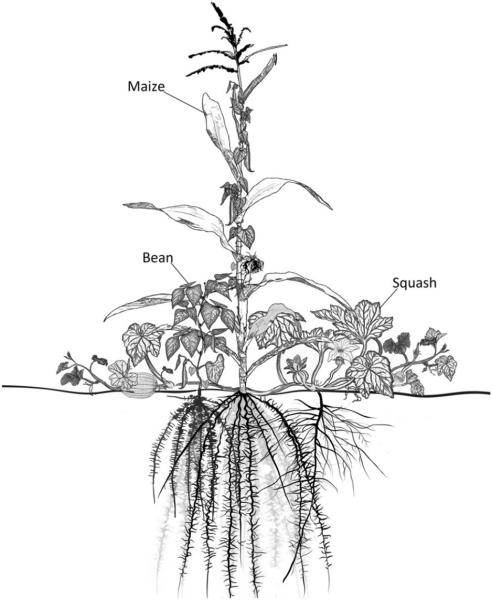
One of the most remarkable Indigenous agricultural systems involved growing maize, beans, and squash together—a method now known as the “Three Sisters.” This system created a natural synergy: maize (corn) grew tall, providing the vertical support for climbing beans, beans restored nitrogen to the soil, and squash spread across the ground, insulating the soil and suppressing weeds. This trio was not just efficient; it reflected a deep understanding of ecological relationships and became an agricultural foundation for numerous Indigenous societies across the hemisphere.
(USDA/NAL)
From Fields to Villages
As domesticated crops became more dependable, human mobility patterns changed dramatically. Farming did not completely replace hunting and gathering—many communities continued mixed subsistence practices—but agriculture provided a more stable and predictable food supply.
Sedentary Life Emerges
Permanent and semi-permanent settlements began to form where farming was reliable. In many regions, families constructed homes, storage pits for food, and communal structures. Villages expanded as seasonal movements grew shorter, and populations increased as food became more abundant. Archaeological evidence from regions such as the American Southwest and Mesoamerica demonstrates that by 5,900 years before present, settlement patterns were shifting toward long-term settlement. (Encyclopaedia Britannica)
Food Surplus and Social Change
Food surpluses changed how communities were organized. When a society could grow and store more food than it immediately needed, not everyone had to farm full-time. This allowed for specialization:
- some people focused on crafting pottery or stone tools,
- others conducted long-distance trade,
- some became religious leaders, engineers, or healers,
- while others coordinated construction or farming schedules.
These transformations laid the groundwork for greater social complexity.
The Emergence of Complex Societies
Agriculture did not simply support larger populations—it provided the economic foundation required for developing monumental architecture, political leadership, long-distance trade networks, and ceremonial life.
Mesoamerica: A Fertile Cradle
In Mesoamerica, the intensification of maize, bean, and squash agriculture produced some of the earliest complex societies in the Americas. Farming supported the development of hierarchical leadership, specialized artisans, and extensive trade routes that moved obsidian, jade, shell, cacao, and textiles across long distances.
Agricultural surplus allowed communities to build plazas, ritual mounds, ballcourts, and temples, as seen among early cultures such as the Olmec.
Agricultural Knowledge as Cultural Knowledge
Agriculture was not only an economic transformation—it influenced religion, identity, and worldviews. Many Indigenous groups developed seasonal calendars tied to planting and harvesting cycles. Ceremonies honored the spirits of maize, rain, and fertility. Stories and oral traditions passed down agricultural knowledge alongside cultural values.
Regional Diversity
While agriculture became central to many societies, its development was not uniform. Geography mattered:
- River valleys supported irrigation agriculture;
- Highland regions developed terrace farming;
- Arid climates required advanced water control;
- Forested regions adapted shifting cultivation systems.
This diversity shows how deeply agriculture was shaped by local environments and how creatively Indigenous peoples responded to them. (Norton – Worlds Together, Worlds Apart)
Why Agriculture Transformed the Americas
By enabling people to settle, farm, store food, and raise larger populations, agriculture created the conditions for immense cultural growth. It led to:
- permanent villages and towns
- ceremonial centers and religious traditions
- advances in engineering, astronomy, and mathematics
- social roles and specialization
- the formation of states and empires
Agriculture did more than feed people—it reshaped human relationships, landscapes, communities, and ultimately the course of history across the Americas.
Sources
- Agriculture in North America. Encyclopaedia Britannica. https://www.britannica.com/topic/agriculture/North-America
- Populating the Americas. Pressbooks. https://pressbooks.pub/abriefhistory1/chapter/populating-the-americas/
- Populating & Settling the Americas. Fiveable. https://fiveable.me/world-history-to-1500/unit-8/1-populating-settling-americas/study-guide/kpBRWlzJv5XJWjPS
- Development of Agriculture. National Geographic Education. https://education.nationalgeographic.org/resource/development-agriculture/
- Three Sisters. USDA/NAL. https://www.nal.usda.gov/collections/stories/three-sisters
Worlds Together, Worlds Apart (Norton).
https://nerd.wwnorton.com/ebooks/epub/worldstogether7/EPUB/content/1.6-chapter01.xhtml