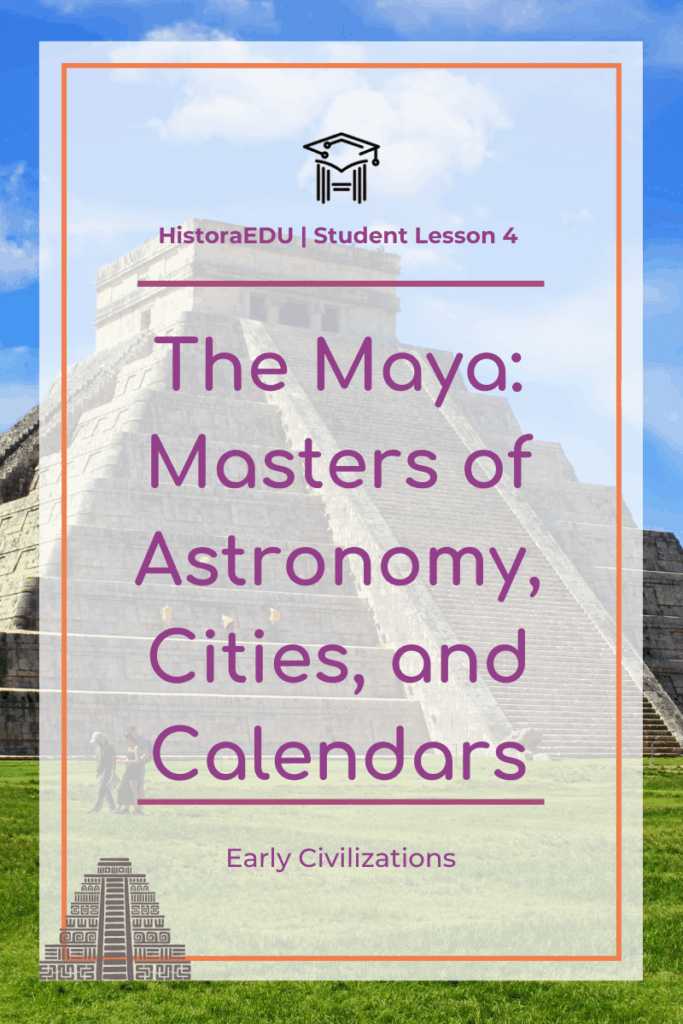
Across the tropical forests, volcanic highlands, and limestone plains of what is now Mexico, Guatemala, Belize, Honduras, and El Salvador, the Maya civilization rose as one of the most innovative and intellectually sophisticated cultures of the ancient world. Between roughly 250 and 900 CE, Maya cities reached extraordinary heights—pyramid temples towering above vast plazas, observatories aligned to the motions of the heavens, and palaces echoing with ceremony, governance, and scholarly debate.
What defined the Maya was not simply their architecture but their worldview. They were farmers, astronomers, mathematicians, engineers, artists, diplomats, and philosophers. Their environment presented both opportunities and challenges, yet they transformed the land into a thriving cultural mosaic of interconnected city-states, complex writing and mathematics, and a deeply spiritual agricultural system that sustained millions.
This chapter explores how the Maya adapted to their environment, built powerful city-states, developed astonishing writing and mathematical systems, and created agricultural practices that supported an entire civilization.
Environment & Adaptations
The Maya homeland was environmentally diverse and often unpredictable. Rather than controlling the land in a uniform way, the Maya developed regionally specific solutions that reflected the landscapes they inhabited.
A Region of Contrasts
The Maya world can be divided into three major zones:
- The Northern Lowlands of the Yucatán Peninsula, defined by porous limestone, scarce surface water, and seasonal droughts.
- The Southern Lowlands, dense with tropical rainforest, rivers, and rich biodiversity but marked by fragile soils.
- The Highlands, with volcanic mountains, fertile valleys, obsidian sources, and cooler climates.
Farming the Land
To farm successfully, the Maya used multiple strategies:
- Raised fields to protect shallow soils
- Terraces on hillsides to prevent erosion
- Swidden (slash-and-burn) agriculture to renew soil nutrients
- Drained fields and canals in swampy lowlands
- Reservoirs (aguadas) to store water during long dry seasons
(Maya Civilization – Britannica; History.com; Digital Maps of the Ancient World)
Engineering the Landscape
The Maya were not passive inhabitants of their environment. They reshaped it:
- Carved reservoirs (aguadas) to store water during dry seasons
- Built causeways (sacbeob) that connected cities across miles of lowland forest
- Created hillside terraces that prevented erosion and expanded farmland
- Dug canals in lowland swamps to irrigate crops and expand settlements
These adaptations sustained large populations—even in regions that lacked rivers or naturally fertile soil. The Maya ability to thrive in challenging ecosystems is one of the clearest signs of their ingenuity.
Maya City-States: Urban Centers of Power
Unlike empires ruled by a single unified government, the Maya world was composed of dozens of independent city-states—each ruled by its own king (ajaw), supported by nobles, priests, scribes, and skilled artisans.
The Structure of a City-State
A typical Maya city-state included:
- A central ceremonial core with temples, pyramids, and plazas
- Palaces where rulers lived and governed
- Ballcourts used for ritual games and political events
- Residential areas for nobles and commoners
- Marketplace districts for trade
- Agricultural zones that stretched into the countryside
Cities such as Tikal, Palenque, Calakmul, Copán, and Chichén Itzá were political, economic, and religious powerhouses. Their architecture was intentionally theatrical—designed to showcase the authority of kings and the connection between rulers, ancestors, and gods.
(History.com; Digital Maps of the Ancient World)
Rivalry and Diplomacy
City-states formed alliances, traded resources, negotiated marriages between royal families, and occasionally engaged in warfare. The political landscape resembled a dynamic network of shifting power rather than a single centralized empire.
Diplomacy was sophisticated: envoys traveled between cities, tribute systems developed, and scribes recorded political events on stone monuments (stelae) to commemorate victories, alliances, and royal ceremonies.
(Maya Civilization – Britannica)
Writing & Math: Intellectual Achievements
The Maya developed the most complex writing system in ancient North America and one of the most advanced mathematical traditions in the world.
The Maya Script
The Maya writing system is logosyllabic, meaning it combines:
- Logograms (symbols representing whole words)
- Syllabic glyphs (symbols representing sounds)
Thousands of inscriptions survive on:
- Stelae
- Temple stairways
- Pottery
- Shell ornaments
- Bark-paper codices
Maya writing recorded history, astronomy, mythology, royal genealogies, mathematical calculations, and ritual events. Far from being a mysterious “lost language,” Maya script has been largely deciphered since the late 20th century and continues to reveal new insights every year.
(Britannica– Maya Civilization)
Mathematics and the Concept of Zero
The Maya were one of the earliest civilizations to use zero as a mathematical placeholder—a concept not adopted in Europe until centuries later. Their vigesimal (base-20) number system allowed them to calculate enormous spans of time, track planetary cycles, and structure complex calendar systems.
(History.com)
Astronomy and Calendars
The Maya observed the movements of the sun, moon, and planets with extraordinary precision. They built observatories, aligned buildings with solstices and equinoxes, and timed rituals to astronomical events.
Their calendar systems included:
- The Tzolk’in (260 days): ritual and divinatory cycle
- The Haab’ (365 days): solar year
- The Long Count: a chronological system capable of tracking millions of days
These calendars were tools of both science and spirituality; they helped time agricultural cycles, royal ceremonies, warfare, and religious festivals.
(DDRN; arXiv)
Agriculture: The Foundation of Maya Civilization
Below the temples and palaces, beyond the markets and causeways, Maya civilization rested on the work of millions of farmers.
Core Crops
Maya agriculture revolved around:
- Maize: dietary staple and sacred symbol
- Beans: source of protein, essential companion to maize
- Squash: provided nutrients and protected soil when intercropped
- Chili peppers, manioc, cotton, cacao, and fruit trees
(History.com)
Together, these crops supported dense populations and vibrant cities.
Farming Techniques
Agricultural methods varied by region and included:
- Terraces on highland slopes
- Raised fields in floodplains
- Swidden, used strategically with long fallow periods
- Irrigation canals and reservoirs
- Forest gardens, where farmers cultivated layered ecosystems resembling wild forests
These methods demonstrate ecological intelligence: farmers maintained soil fertility, managed water, diversified crops, and minimized environmental damage.
Food, Power, and Ritual
Agriculture was not simply economic—it was deeply woven into Maya culture. Maize itself was sacred; in Maya creation stories, humans were formed from ground maize dough. Kings performed rituals to ensure agricultural fertility, reinforcing their spiritual authority. Seasonal ceremonies aligned with the agricultural calendar, blending science, religion, and community life.
Summary
The Maya civilization was a tapestry of intellectual, architectural, agricultural, and artistic achievements. Their ability to adapt to challenging environments allowed them to build cities in the rainforest. Their political structures encouraged vibrant cultural exchange. Their writing and mathematics advanced human knowledge. Their agricultural systems sustained millions for centuries.
The Maya were not simply great builders or sky-watchers—they were innovators whose achievements continue to inspire awe. Their descendants still carry Maya languages, traditions, and agricultural practices into the present, keeping this remarkable heritage alive.
Sources
- Maya People. Encyclopaedia Britannica. https://www.britannica.com/topic/Maya-people
- “Mayan Civilization: Calendar, Pyramids & Ruins.” History.com. https://www.history.com/articles/maya
- Living Maya Time. Smithsonian Institution. https://maya.nmai.si.edu/maya
- “How Did Ancient Maya Civilization Influence the Modern World?” DDRN. https://ddrn.dk/16219/
- “The Maya Civilization.” Digital Maps of the Ancient World. https://digitalmapsoftheancientworld.com/ancient-history/the-history-of-the-maya/