
If you’ve ever wrapped up your unit on the New Nation and immediately sensed glazed eyes as soon as you say “review day,” you are definitely in good company. The transition from the American Revolution to the early years of the United States — interpreting the Constitution, comparing the views of early leaders, and understanding how the first presidents shaped the nation — is rich with content but not always easy for students to hold onto. It’s full of big ideas and nuanced debates that middle schoolers often struggle to connect without a little extra support.
That was exactly my experience teaching the New Nation unit. We would spend weeks unpacking Hamilton vs. Jefferson, the creation of the federal government, and early precedents set by Washington and Adams, and students would seem to understand… until a review session exposed all the misconceptions. Suddenly we’d be revisiting questions like “Wait, who wanted a national bank again?” or “What was the Whiskey Rebellion about?” far more often than I’d like.
At some point I realized I needed a tool that would let students practice the content — not just reread it. Something that would make review feel less like circling back and more like building confidence. That’s how the New Nation Review Game was born: a lively, interactive experience that turns test prep into genuine learning instead of busywork.
Let’s talk through why this part of U.S. History can be challenging for students, what they really need to understand, and how an interactive review game can shift your review days from painful to productive.

Why New Nation Test Prep Can Be Tricky
The New Nation unit sits at a crossroads in middle school social studies where content stops being just “what happened” and starts being why it happened and how it mattered. That’s a leap for many learners who have spent most of their year memorizing people and places rather than wrestling with competing ideas and long-term consequences.
Some recurring challenges I noticed in my own classroom included:
- Confusion about early leaders’ priorities. Students often remember names like Washington or Jefferson, but struggle to articulate how their visions for America differed.
- Blurring of events and policies. The Whiskey Rebellion, the Neutrality Proclamation, and the Alien & Sedition Acts are all part of this unit, and students tend to mix up what each was about and why it mattered.
- Difficulty with abstract concepts. Ideas like federalism, national debt, and states’ rights aren’t as straightforward as a map quiz — and they don’t come alive unless students see them in action.
And the most surprising part? My students wanted to understand this unit. They genuinely liked debates about government powers and enjoyed talking about historical decisions… until the test neared and everything started to feel like “just another review.” Study guides and flashcards just weren’t cutting it.
That’s when I knew I needed a review approach that matched the energy and complexity of the content — something interactive, collaborative, and meaningful.
What Students Need to Know About the New Nation
Before students can approach a New Nation or Founding Fathers test with confidence, they need a solid grasp of several overarching ideas. Too often, review focuses on isolated facts — but the way students connect those facts is what leads to real understanding.
Leadership and Vision
Students should be able to explain how early leaders had different visions for the country. For example:
- Alexander Hamilton believed in a strong central government and national bank.
- Thomas Jefferson favored a more agrarian society and stronger state powers.
Helping students see these views as competing visions gives context that makes the details stick.
Federalism and Government Structure
This unit reintroduces foundational civics concepts:
- What powers belong to the federal government?
- What powers belong to the states?
- How did early policies reinforce or challenge these boundaries?
These are complex ideas, and students need repeated engagement to internalize them.
Precedents Set by Early Leaders
The actions of George Washington — like forming a cabinet or stepping down after two terms — weren’t just events; they established norms. Asking students why that mattered helps them build historical reasoning.
Key Events and Policies
Understanding the significance of things like:
- The Whiskey Rebellion
- The Neutrality Proclamation
- Jay’s Treaty
- The Alien & Sedition Acts
…requires students to connect cause and effect, not just memorize dates.
When review focuses on relationships among these ideas instead of isolated memorization, understanding deepens — and learning becomes meaningful.
Why Review Games Help With Complex Content
Middle schoolers are thinkers, talkers, and often discourse learners — meaning they build knowledge through discussion, debate, and active retrieval, not just passive reading.
Traditional review methods — rereading notes, completing worksheets, reciting flashcards — tend to push students into passive mode. It looks like study, but it doesn’t engage the brain in the hard work of retrieving and applying knowledge.
Interactive review games, on the other hand, do something powerful:
- They require active recall, which research shows is one of the most effective ways to strengthen memory.
- They create opportunities for students to talk history, which deepens connection to the content.
- They build low-stakes confidence, especially for students who freeze up around tests.
- They make review feel like learning, not just exam prep.
In short: kids engage. They think. They correct. And they learn.
And as a teacher? You get to observe learning in action instead of just hoping it happened.
Inside the New Nation Review Game
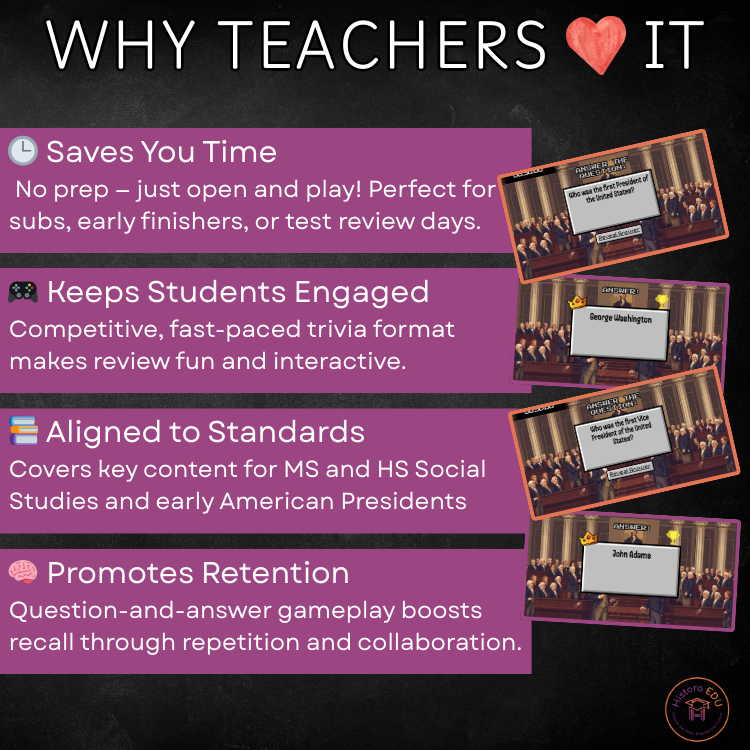
This New Nation Review Game covers all of the major content students need for a Founding Fathers and early government test — and it does so in a way that feels interactive instead of static.
Within the game, students revisit:
- Competing visions of early leaders (Hamilton vs. Jefferson vs. Washington)
- Key policies and their impacts
- How the first government operated
- Challenges faced by the New Nation
- The evolution of political parties and public opinion
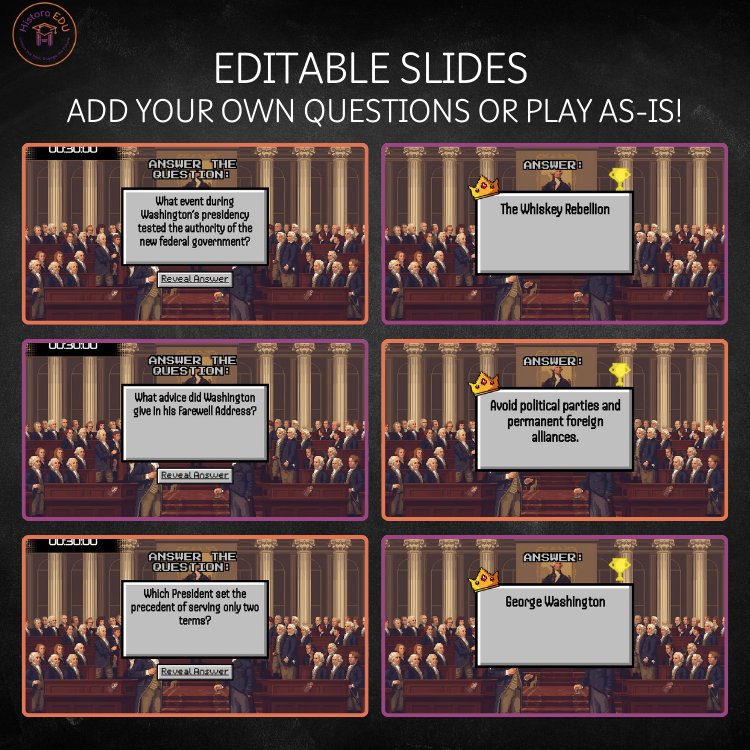
Teachers receive an interactive digital version of the game along with a student-ready gameplay link and an editable version so you can customize the experience if needed. It’s designed to work across multiple class structures — whole group, partners, small groups, or stations.
Students engage with meaningful questions that naturally prompt them to connect ideas rather than simply retrieve definitions. That’s the magic of this format.
And it’s flexible: some classes play it in 20-minute chunks, others make it their core review activity in a 40-minute block. You can adapt it to fit your pacing with ease.
How to Use the New Nation Review Game in Your Classroom
There’s no single “right way” to use this game, which is one reason teachers love it.
One of my favorite strategies is what I call historical rounds: I divide the class into teams and use whiteboards for quick responses. Students cheer, laugh, and — more importantly — discuss why an answer makes sense. These conversations are where learning happens.
Another powerful routine is pairing the game with station rotations. In one station, students might map early political divisions. In another, they might analyze excerpts from early speeches or letters. The review game becomes one station among many, and the variety keeps energy up and engagement strong.
For classes that benefit from more targeted support, the game works beautifully in small groups or partner play. Students explain answers to each other, negotiate ideas, and learn from peers — especially useful for learners who need extra practice with nuance.
And yes — this is also an excellent sub plan. Because the game is student-ready and self-explaining, even in your absence students engage with the review content meaningfully instead of defaulting to busywork.
If you’re looking for a review tool that feels intentional and works in real classroom conditions, this game will fit beautifully.
Differentiation & Support Ideas
Review games naturally lend themselves to support strategies for diverse learners, but there are ways you can stretch this one even further.
For students who need a bit more structure, consider letting them use guided notes during the first round. Pairing them with a partner can also hold space for discussion while reducing anxiety.
If you want to use the game as a formative assessment, pull a few key questions and turn them into exit tickets or quick reflective prompts. This gives you insight into where students are still struggling.
For students ready to deepen their understanding, try adding short writing extensions like:
“Explain how the conflict between Hamilton and Jefferson shaped the early political system.”
or
“Choose one policy from the New Nation era and explain how it affected ordinary citizens.”
These help students move beyond recall and into historical reasoning — exactly the kind of higher-order thinking that pays off on assessments.
Where to Get the New Nation Review Game (+ Future Resources)
If you’re ready to make your New Nation test prep more engaging and effective, you can find the full game here:
👉 New Nation Review Game | Founding Fathers & Early Government Test Prep
If you teach 7th or 8th grade, or a full high school U.S. History course, this game is also part of two larger bundles designed to save you planning time and give you a complete, ready-to-teach review system for the entire year.
This bundle includes all the major review games for the first half of U.S. History, so you never have to scramble for test prep again — Indigenous America, Exploration, Colonization, 13 Colonies, American Revolution, Constitution, and more. It’s perfect if you want consistent, interactive, low-prep review days built right into your pacing.
If you’re ready to completely streamline your year, this bundle covers every unit from day one through the end-of-year final exam. Every review game follows the same structure, the same look, and the same ease-of-use — which means your students always know what to expect, and you always have a reliable test prep tool at your fingertips.
If you want a complete, consistent review system for the entire year — from Indigenous America all the way through Reconstruction — this bundle gives you everything you need.
Teachers love these bundles because they reduce prep time and give students a familiar, predictable format for test review across every unit.
⭐ Thanks for Teaching With HistoraEDU
I’m so glad you’re here. My goal with HistoraEDU is to help you bring history to life in ways that feel meaningful, engaging, and realistic for a busy classroom. If you want more teaching tips, new activities, and exclusive freebies straight to your inbox, join the HistoraEDU teacher community below. You’ll get access to my Teacher Toolkit, early product releases, classroom-tested strategies, and seasonal freebies sent right to your inbox.
📬 Join the HistoraEDU Email List
Where history teachers get smarter strategies — not more work.
Whether you’re here for engaging lessons, low-prep review games, or just a spark of inspiration on a long Tuesday afternoon, I’m glad you’re part of this community. More resources, classroom stories, and ready-to-teach materials are on the way — and I can’t wait to share them with you!
Happy teaching,
Sarah @ HistoraEDU


