
If you’ve ever taught the Westward Expansion and Manifest Destiny to your middle school students, you know it starts with big questions: What fueled the drive West? Why did people leave everything they knew? And how did this idea transform a continent… for better and worse?
But by the time you reach review week, those profound conversations often devolve into a messy jumble of names, dates, maps, and mixed metaphors. Suddenly, Manifest Destiny is no longer a compelling story about ideas and movement — it’s a list of ‘facts-to-memorize,’ and students glaze over.
I remember the year I realized something wasn’t working. We had spent weeks unpacking the causes of Westward Expansion, the impacts on Native Nations, the Louisiana Purchase, the Oregon Trail, and the Mexican-American War. Students asked thoughtful questions and made connections in class. But then review day arrived, and I was met with blank stares. “Wait — what was the point of Manifest Destiny again?” one student asked with total sincerity.
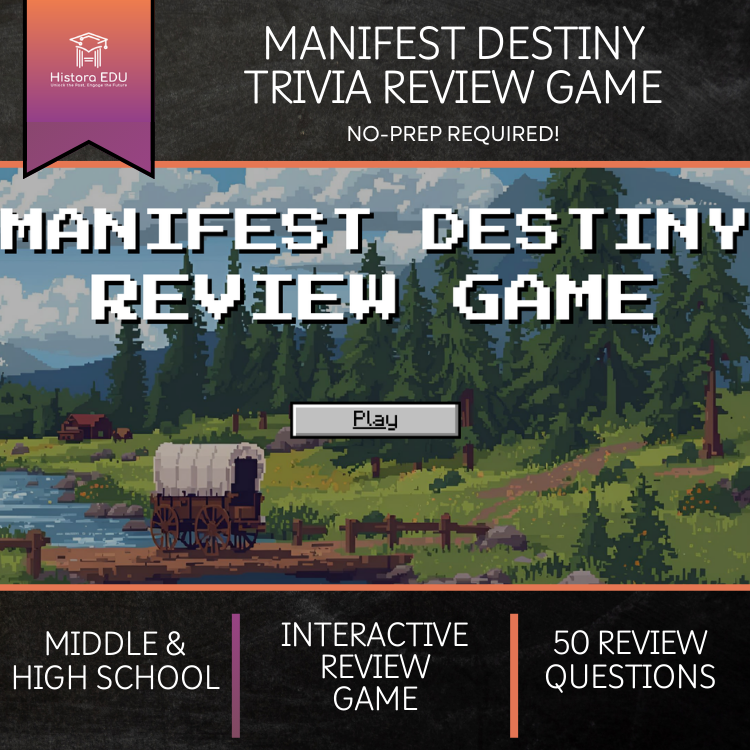
At that moment, I knew I needed a different kind of review — something that activated their thinking, not just recycled content. That’s when I created the Manifest Destiny Review Game: a way to transform review into a dynamic discussion that honors student curiosity and builds deeper understanding.
Let’s explore why this unit can be so tricky for learners, what students really need to grasp, and how an interactive game can turn review into a meaningful learning experience.
Why Manifest Destiny Test Prep Is Tougher Than It Looks
Manifest Destiny isn’t just a term on a vocabulary list. It’s an idea — a mindset that shaped U.S. history in profound and complicated ways. That’s why many students can recall a definition but still struggle to explain it.
Here’s what I see classroom after classroom grapple with:
1. The concept feels abstract
Manifest Destiny isn’t a battle or a treaty — it’s a belief that the United States was destined to expand across a continent. Students hear the words but don’t always connect them to real decisions people made.
2. There are messy moral questions
Expansion meant opportunity for some — land, wealth, adventure — but it also brought displacement, conflict, and cultural erasure. Middle schoolers want clarity, but this unit demands nuance.
3. So many events get bundled together
Louisiana Purchase, the Oregon Territory, the Trail of Tears, the Mexican-American War — students often lump these topics together without understanding why each mattered.
When review focuses on memorization alone, students miss the story of Manifest Destiny. They miss the connections, and that’s where understanding collapses.
That’s why an interactive, idea-centered review is so powerful. It helps students think through the why and how — not just the when.
What Students Really Need to Grasp About Manifest Destiny
Before students can successfully explain Manifest Destiny on an assessment, they need to understand a few key threads woven through the unit.
Beliefs and Motivations
Manifest Destiny wasn’t an event — it was an idea that influenced actions. Students need to see how belief in expansion drove decisions about land, politics, and culture.
When I work through this with my classes, we spend time looking at:
- Why people moved west
- How newspapers and speeches popularized the idea
- How government policies reflected and reinforced the belief
Movement and Experience
The story of Westward Expansion isn’t complete without:
- Families traveling on the Oregon Trail
- People settling new territories
- Encounters with Indigenous Nations
- Hardships and hope in equal measure
Students need to see voices and choices — not just maps and dates.
Consequences
Manifest Destiny shaped the nation — for everyone — and not always in positive ways. Students must consider:
- Conflict and treaty negotiations with Native nations
- The Mexican-American War and its outcomes
- How expansion reinforced ideas about power and identity in the U.S.
When students begin to connect these ideas, they start seeing Manifest Destiny as a thread in a narrative, not a list of disconnected facts.
Why Review Games Are So Effective for Manifest Destiny
Middle school classrooms thrive on interaction. Students learn when they talk, debate, and test their ideas aloud — not when they quietly reread notes.
A review game engages students in ways that worksheets and packets simply don’t. Instead of passively flipping pages, students are:
- Actively recalling information
- Explaining reasoning to peers
- Competing in a low-risk environment
- Reflecting on misunderstandings in real time
And the best part is that they begin to understand relationships — between ideas, events, and consequences — instead of memorizing disconnected details.
For teachers, review games also solve a big problem: consistency of engagement. Every student participates. The class stays active. And you get rich insight into where students still struggle.
Inside the Manifest Destiny Review Game
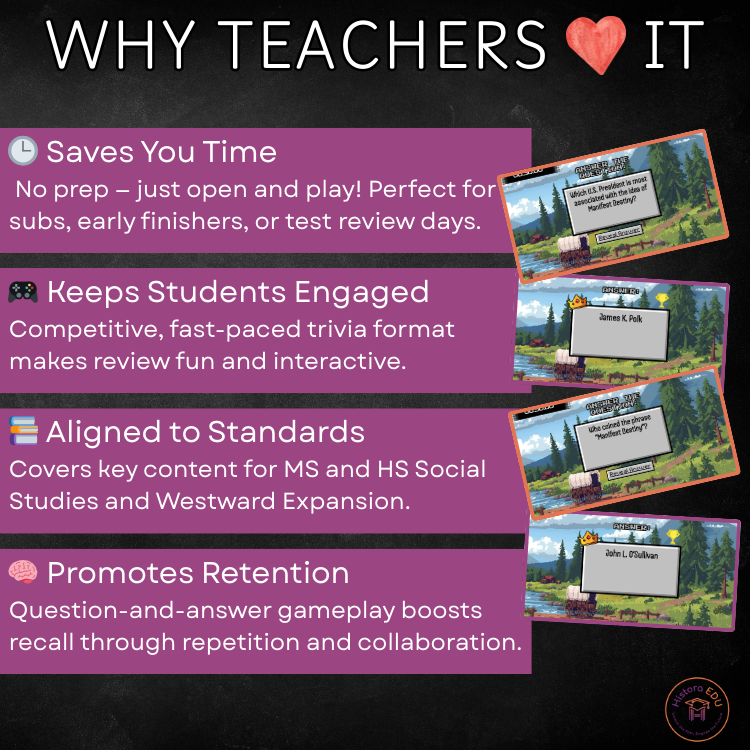
The Manifest Destiny Review Game is built to help students revisit core content through questions that spark thought, not just recall.
Students will review:
- The meaning and origins of Manifest Destiny
- Major events tied to Westward Expansion
- Experiences of people on the move (trail life, settlement patterns)
- U.S. policy decisions that shaped the nation’s growth
- Indigenous resistance and the cost of expansion
Teachers receive:
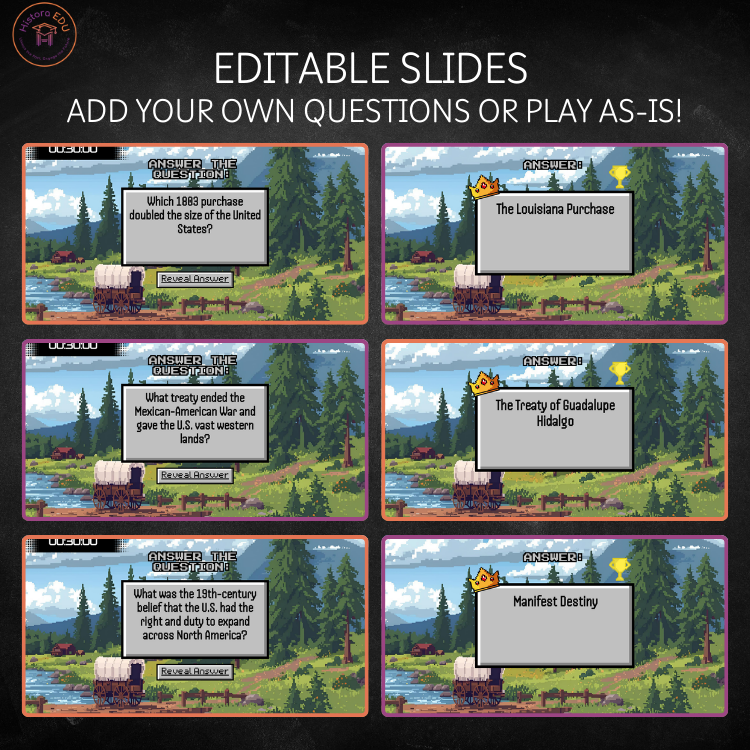
- A digital, interactive version of the game
- A student-friendly gameplay link
- An editable version for tailoring content
- Clear instructions for classroom use
- Questions aligned with common civics and U.S. History standards
This game works well for a 20-minute review block, a full class review day, or even a stations rotation where students tackle different manifestations of Manifest Destiny from multiple angles.
How to Use This Manifest Destiny Review Game in Your Classroom
I’ve found this game works beautifully across several instructional formats, depending on your goals and your students’ needs.
Whole-Class Engagement
Divide students into teams, project the game, and use whiteboards or Google Jamboard for answers. Students love the energy that comes from quick thinking and friendly competition.
This method helps solidify big picture connections while encouraging students to verbalize their reasoning — a key step toward deep understanding.
Station Rotations
Pair the review game with other hands-on tasks:
- A geography station where students map migration routes
- A primary source station with excerpts from settlers or Indigenous voices
- A timeline station where events are put in sequence
This adds movement and reinforces a variety of skills.
Small Groups & Peer Discussion
For students who need extra support or enrichment, small group play helps them talk through their thinking with peers. It becomes a space for coaching, correcting misconceptions, and building confidence.
Sub Plans & Early Finishers
Because the game is student-ready and self-explaining, it makes a phenomenal activity when you need reliable subs or have students who finish early.
No matter how you structure it, this game gives students repeated retrieval practice — one of the best ways to prepare for assessments.
Differentiation & Support Ideas
Every class has a range of learners — and this game adapts well.
For students who benefit from scaffolding, consider letting them:
- Use guided notes in early rounds
- Work with a partner or triad
- Reference anchor charts during play
For students ready to extend their thinking, try adding reflective prompts like:
“Describe how Manifest Destiny shaped the experiences of two groups differently (e.g., settlers vs. Indigenous Nations).”
or
“Explain why the idea of Manifest Destiny gained influence in the 19th century.”
These prompts push students beyond recall and into analysis and synthesis — exactly the thinking we want for deeper civics understanding.
Where to Get the Manifest Destiny Review Game (+ More Review Tools)
If you’re ready to make your Westward Expansion and Manifest Destiny review more engaging and impactful, you can find the full game here:
👉 Manifest Destiny Review Game | Interactive Test Prep & Trivia
If you teach 7th or 8th grade, or a full high school U.S. History course, this game is also part of two larger bundles designed to save you planning time and give you a complete, ready-to-teach review system for the entire year.
This bundle includes all the major review games for the first half of U.S. History, so you never have to scramble for test prep again — Indigenous America, Exploration, Colonization, 13 Colonies, American Revolution, Constitution, and more. It’s perfect if you want consistent, interactive, low-prep review days built right into your pacing.
If you’re ready to completely streamline your year, this bundle covers every unit from day one through the end-of-year final exam. Every review game follows the same structure, the same look, and the same ease-of-use — which means your students always know what to expect, and you always have a reliable test prep tool at your fingertips.
If you want a complete, consistent review system for the entire year — from Indigenous America all the way through Reconstruction — this bundle gives you everything you need.
Teachers love these bundles because they reduce prep time and give students a familiar, predictable format for test review across every unit.
⭐ Thanks for Teaching With HistoraEDU
I’m so glad you’re here. My goal with HistoraEDU is to help you bring history to life in ways that feel meaningful, engaging, and realistic for a busy classroom. If you want more teaching tips, new activities, and exclusive freebies straight to your inbox, join the HistoraEDU teacher community below. You’ll get access to my Teacher Toolkit, early product releases, classroom-tested strategies, and seasonal freebies sent right to your inbox.
📬 Join the HistoraEDU Email List
Where history teachers get smarter strategies — not more work.
Whether you’re here for engaging lessons, low-prep review games, or just a spark of inspiration on a long Tuesday afternoon, I’m glad you’re part of this community. More resources, classroom stories, and ready-to-teach materials are on the way — and I can’t wait to share them with you!
Happy teaching,
Sarah @ HistoraEDU


