If there’s one unit in U.S. History that consistently trips up even the most engaged middle schoolers, it’s Reconstruction. Students come out of the Civil War unit armed with battles, generals, and outcomes — but the post-war era? That’s a different kind of challenge.
They ask honest, deeply insightful questions like:
- Why didn’t freedom automatically mean equality?
- What even was the 14th Amendment?
- Why did Reconstruction end?
- What’s the difference between sharecropping and slavery?
But when it comes time to review for a test, those nuanced questions get buried under a pile of dates, laws, and names that feel disconnected and confusing. In other words: students think they understand Reconstruction until they have to explain it aloud.
That disconnect is exactly what made me rethink how I approach review for this unit. Rather than more worksheets or flashcards, I needed a strategy that got students talking, connecting, reasoning, and retrieving information in context — not rote memorization.
That’s where the Reconstruction Review Game comes in: a classroom-tested, interactive way to help students sort through the complexity of Reconstruction and build real historical understanding.
In this post, we’ll explore why students struggle with Reconstruction, what they really need to grasp, and how an interactive review experience can dramatically improve their thinking before a test.

Why Reconstruction Is One of the Hardest Units to Review
Most teachers expect Civil War understanding to break down into a series of events that led to obvious outcomes. But Reconstruction is not a story with a clear beginning, middle, and end — at least not in the way students are used to.
It’s messy. It’s contested. It’s about competing visions of freedom, citizenship, power, and identity. And students are rarely given enough opportunities to dig into why these conflicts matter, not just what they were.
Here are a few patterns I see in classrooms:
1. Students think the Civil War ended the story
Many learners assume that once the Confederacy fell, the work of rebuilding the nation was simple or inevitable. They’re surprised to learn that Reconstruction was hotly contested and fundamentally political.
2. Vocabulary hides real understanding
Terms like freedmen’s bureaus, Black Codes, carpetbaggers, sharecropping, and even Reconstruction itself feel like flashcard fodder — until students are asked to explain what these things meant for people’s lives.
3. Outcomes aren’t always intuitive
Unlike most units where victory equals clarity, Reconstruction ends with ambiguity — many reforms are rolled back, and the promise of the 14th and 15th Amendments was only partially fulfilled for decades. That’s a history kids want to Understand, not just Recall.
And that’s exactly where traditional review falls short. Students memorize terms without connecting them to lived experiences or structural change.
That gap is where an interactive, discussion-oriented review becomes not just helpful — but essential.
What Students Need to Understand About Reconstruction
Before students can approach a Reconstruction test with confidence, they need a scaffolded sense of the unit’s core themes, conflicts, and continuities.
Competing Visions of Rebuilding the Nation
Students should see Reconstruction as a debate, not a checklist:
- What should freedom look like after slavery?
- Who should have political power in the South?
- How much federal authority should be used to guarantee rights?
These questions set up the unit as a series of competing ideas — not just dates.
Amendments and Legal Change
Memorizing the 13th, 14th, and 15th Amendments is good — but students need to understand:
- What did these amendments promise?
- Why were they necessary?
- How did different groups react to them?
When students frame these amendments around purpose and impact, the content becomes meaningful.
Resistance & Backlash
Reconstruction was followed by intense resistance — from Black Codes to Jim Crow laws. Students need to grapple with:
- How progress can be contested
- Why legal change doesn’t always equal lived change
These aren’t simple answers, but they are essential for deep understanding.
When students begin to see these ideas as interconnected — and when they practice pulling them together — the unit stops being a jumble of definitions and becomes a narrative about power and transformation.
How Interactive Review Helps Students Make Sense of Complexity
Middle school students think historically when they’re asked to compare, contrast, analyze causes and effects, and make judgments about evidence and outcomes. That’s what historians do — and that’s what we want our students to learn.
Traditional review is often transactional: memorize this, recall that, repeat. But historical thinking demands connections:
- Why did sharecropping replace slavery?
- How did the Freedmen’s Bureau help — and why wasn’t it enough?
- What was the significance of the Reconstruction Amendments?
- Why did Reconstruction end when it did?
Interactive review formats give students repeated chances to practice these cognitive moves.
A review game doesn’t just ask “What is…” It asks “Why does this matter?” and “How does this connect to that?”
And because students are talking, debating, and retrieving information, they’re building neural connections that last beyond the test.
Inside the Reconstruction Review Game
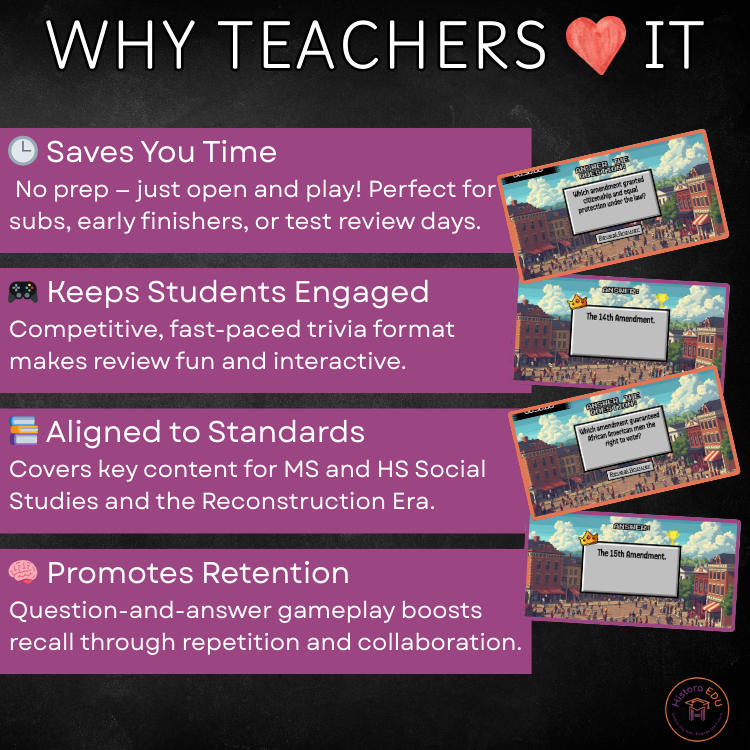
That brings us to the Reconstruction Review Game — a tool designed not just to jog memories, but to activate historical thinking in your classroom.
This game invites students to revisit:
- Big ideas like freedom, citizenship, and political power
- Reconstruction Amendments and their implications
- Social and economic transitions in the post-Civil War South
- Resistance movements and the rollback of reforms
- Connections between Reconstruction and later civil rights movements
Rather than isolated facts, the questions are crafted to make students think contextually — how events and policies relate to each other and why outcomes unfolded the way they did.
Here’s what you get as a teacher:
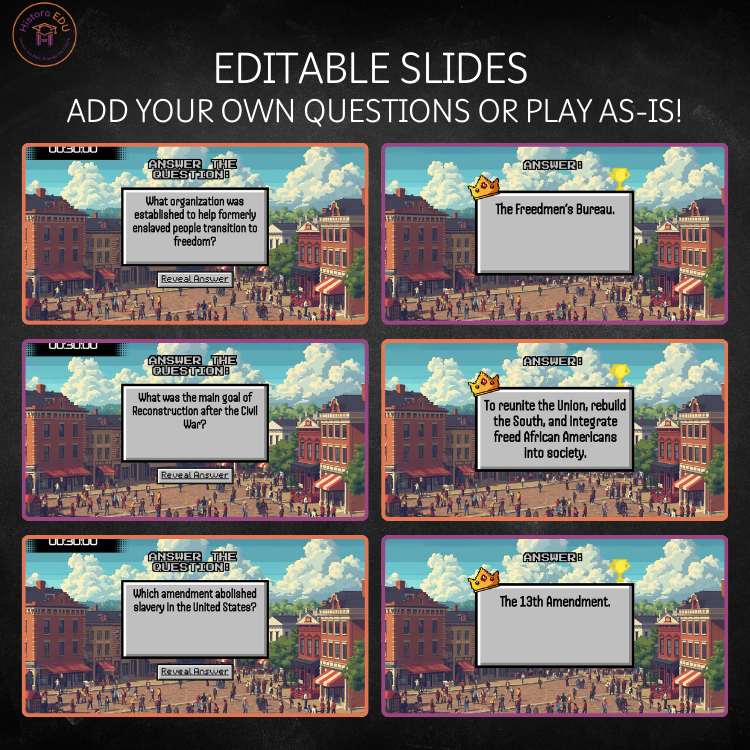
- A digital interactive version of the game that’s ready to share
- A student-friendly gameplay link
- An editable version so you can tailor questions or pacing
- A set of questions aligned to middle school standards and historical thinking skills
You can use the game in:
- A 20–minute review block
- A full class period
- Station rotations
- Small group discussions
- Sub plans
It’s flexible and adaptable to your classroom’s needs.
👉 You can find the Reconstruction Review Game on TPT here
How to Use This Review Game in Your Classroom
The power of this game really comes from how you use it. Here are a few strategies that take it beyond trivia:
Compare and Contrast Rounds
After a game round, pose a discussion prompt like:
- “Compare the goals of Radical Republicans with the rights promised in the 14th Amendment.”
Students explain their reasoning and deepen thinking.
Sequence Stories
Ask students to connect major developments in Reconstruction:
- Emancipation → Freedmen’s Bureau → Black Codes → Civil Rights Act of 1866 …
This makes the content feel like a narrative, not a jumble.
Perspective Talk
Encourage students to answer questions from different points of view — a freedperson, a Southern landowner, a Northern politician — to deepen empathy and context.
These routines add layers of thinking beyond simple recall.
Differentiation & Extension Ideas
Every classroom has a mix of learners; here’s how to adapt:
- Students who need more structure: Let them use notes the first round, then gradually reduce supports.
- Students ready for deeper work: Ask them to write short explanations for why each answer is correct.
- Early finishers: Invite them to create their own review questions and swap with classmates.
- Reflection output: Have students answer a big question like:
“Why did Reconstruction end, and what were the long-term consequences for American society?”
These extensions make the game a launchpad for deeper historical reasoning.
Where to Get the Reconstruction Review Game (+ Framework Resources)
If you’re ready to make your Reconstruction review more meaningful and engaging, you can find the full game here:
👉 Reconstruction Review Game | Interactive Test Prep & Trivia
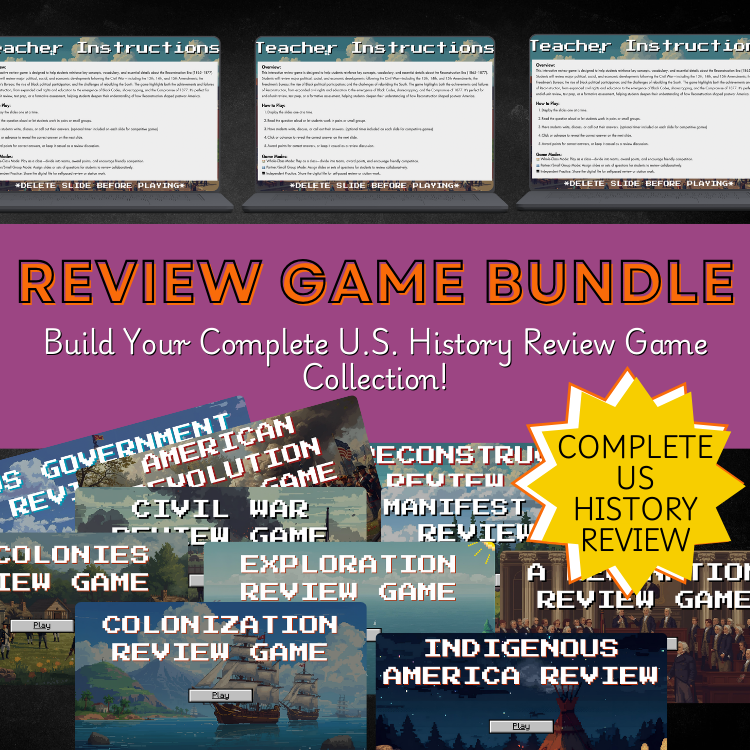
If you teach 7th or 8th grade, or a full high school U.S. History course, this game is also part of two larger bundles designed to save you planning time and give you a complete, ready-to-teach review system for the entire year.
This bundle includes all the major review games for the first half of U.S. History, so you never have to scramble for test prep again — Indigenous America, Exploration, Colonization, 13 Colonies, American Revolution, Constitution, and more. It’s perfect if you want consistent, interactive, low-prep review days built right into your pacing.
If you’re ready to completely streamline your year, this bundle covers every unit from day one through the end-of-year final exam. Every review game follows the same structure, the same look, and the same ease-of-use — which means your students always know what to expect, and you always have a reliable test prep tool at your fingertips.
If you want a complete, consistent review system for the entire year — from Indigenous America all the way through Reconstruction — this bundle gives you everything you need.
Teachers love these bundles because they reduce prep time and give students a familiar, predictable format for test review across every unit.
⭐ Thanks for Teaching With HistoraEDU
I’m so glad you’re here. My goal with HistoraEDU is to help you bring history to life in ways that feel meaningful, engaging, and realistic for a busy classroom. If you want more teaching tips, new activities, and exclusive freebies straight to your inbox, join the HistoraEDU teacher community below. You’ll get access to my Teacher Toolkit, early product releases, classroom-tested strategies, and seasonal freebies sent right to your inbox.
📬 Join the HistoraEDU Email List
Where history teachers get smarter strategies — not more work.
Whether you’re here for engaging lessons, low-prep review games, or just a spark of inspiration on a long Tuesday afternoon, I’m glad you’re part of this community. More resources, classroom stories, and ready-to-teach materials are on the way — and I can’t wait to share them with you!
Happy teaching,
Sarah @ HistoraEDU