
There’s a joke in the hallways of every middle school social studies department: “You teach the Civil War three times and kids will still mix up the causes.” But it isn’t funny to the teacher who just spent a week reteaching sectional tensions — only to hear a student say “The Civil War was caused by tariffs, right?”
The Civil War unit is one of the most historically rich moments in U.S. History. It touches on economics, politics, culture, human rights, military strategy, presidential leadership, and constitutional questions. That’s part of what makes it amazing — and part of what makes it overwhelming for students.
When it’s time to review for a test, all those threads collide in one massive, interconnected web of ideas. And if your students haven’t had enough meaningful practice pulling those ideas together, they’re likely to get stuck — not because the material is hard, but because the connections are.
That’s the jumping-off point for this blog post: What really confuses students about the Civil War, and how can we help them think historically — not just memorize facts? We’ll explore that first, and then I’ll share a classroom-tested way to make review interactive and effective.

Where Students Get Tripped Up in the Civil War Unit
Instead of starting with a product right away, let’s talk about the real cognitive challenges your students face. Understanding these patterns helps you diagnose misconceptions and address them meaningfully.
Cause vs. Effect Gets Blurry
Most students know that the Civil War happened. Fewer know why it happened, and even fewer understand how those causes connect. They’ll list slavery, tariffs, and states’ rights as separate bullets — as if they were unrelated events — instead of seeing them as intertwined causes with different weight and context.
Confusion Around Key Figures
Abraham Lincoln becomes the guy who ended slavery. Ulysses S. Grant becomes the general who won. Jefferson Davis is the president of the South. But teaching who’s who is one thing — helping students connect what they did to why it mattered is another. Too often students remember names, not roles or reasoning.
Sequential Misunderstandings
Students often jumble the timeline: Was the Emancipation Proclamation before or after Gettysburg? Why was Antietam important? They recognize iconic battles but can’t place them within the bigger causal chain.
Complexity of Motives
When you ask why the Confederacy fought, some students will confidently answer “states’ rights” — without understanding how that concept is tied to the institution of slavery and economic systems. Simplified review can accidentally reinforce confusion.
These challenges aren’t because students can’t learn the material — it’s that their brains need structured practice pulling ideas together in context, not just memorizing discrete facts.
A Shift in Approach: From Memorization to Historical Thinking
Before we talk about any one activity, let’s define what we, as social studies teachers, are really trying to help students do during review:
Think Like Historians
Rather than reciting details, we want students to:
- Evaluate causes and effects
- Compare perspectives (Union vs. Confederacy vs. enslaved people)
- Sequence events within broader context
- Interpret decisions and consequences
This means asking questions like:
- What really drove conflict between North and South?
- Why did Lincoln issue the Emancipation Proclamation when he did?
- How did battlefield outcomes shape public opinion and policy?
When students practice those skills, they build transferable understanding — and that’s what review should be.
How Interactive Review Supports Deeper Historical Thinking
Activities that get students talking, debating, explaining, and justifying are more effective than worksheets because they require:
- Active recall — pulling ideas from memory
- Contextual reasoning — connecting events across time
- Peer discourse — discussing and defending interpretations
- Real-time feedback — clarifying misunderstanding immediately
This is why classroom games — far from being “gimmicky” — are actually powerful cognitive tools. They turn review into thinking practice, not just question answering.
And that’s where the Civil War Review Game comes in.
Inside the Civil War Review Game: More Than Trivia
The Civil War Review Game is not just a collection of questions. It’s a carefully structured activity that encourages students to:
- Compare multiple causes of the Civil War (economic, political, social)
- Explain why specific battles mattered
- Distinguish between what happened and why it mattered
- Think about leadership decisions and their impact
- Reflect on how outcomes shaped the nation
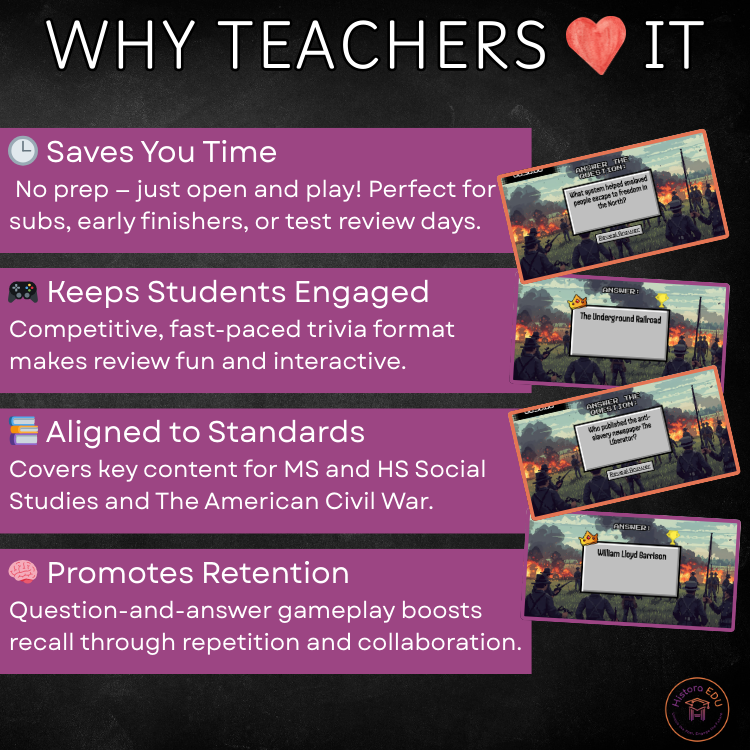
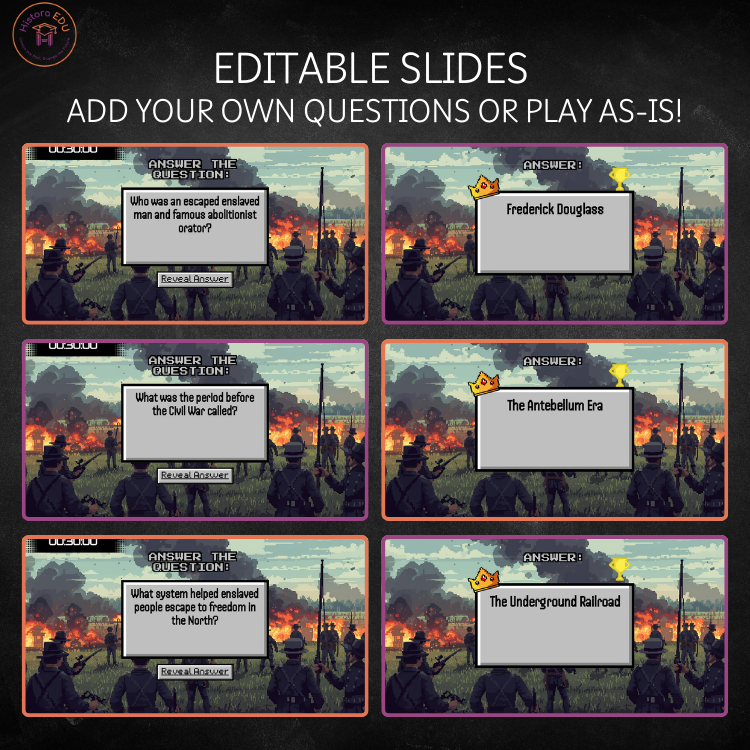
This interactive game includes questions and scenarios that require students to tie ideas together. It’s digital, ready-to-go, and designed with classroom flow in mind.
Here’s what teachers receive:
- A digital interactive game that students can play individually, in pairs, or as teams
- A student-ready gameplay link for easy assignment
- An editable version so you can tailor content to your pacing or standards
- Clear instructions for a range of classroom setups
Whether you have 15 minutes or a full review block, this resource can fit into your rhythm.
👉 Find the Civil War Review Game on TPT here.
Review Strategies That Complement the Game
Let’s talk about how you might use this game within a broader review strategy that develops thinking:
1. Pre-Game Think Aloud
Before playing, invite students to talk through one big question like:
- “What is the most important cause of the Civil War — economic, cultural, legal, or political — and why?”
This primes them to consider relationships rather than isolated facts.
2. Small Group Debates
After a round of game play, pause and let groups discuss:
- “Which Civil War event changed the course of the war — Gettysburg, Antietam, or Vicksburg — and why?”
Students listen to each other’s reasoning, strengthening historical thinking.
3. Evidence-Based Exit Tickets
After a game session, prompt students to write:
- “Explain how one specific Civil War event illustrates a larger historical theme.”
This bridges play with writing and reasoning.
Differentiating Review for Every Learner
Not all students engage with review in the same way — and that’s okay. Here’s how to adapt:
- Struggling learners can play in pairs with guided notes.
- Students who need extension can justify answers with evidence from primary sources.
- Quiet learners might write short explanations after each round.
- Advanced students can lead group discussions between game rounds.
These adaptations allow the same game to work for a spectrum of learners.
Where to Get the Civil War Review Game (and Beyond)
If you’re ready to bring an interactive historical thinking practice to your Civil War unit, you can find the full game here:
👉 Civil War Review Game | Social Studies Interactive Test Prep
If you teach 7th or 8th grade, or a full high school U.S. History course, this game is also part of two larger bundles designed to save you planning time and give you a complete, ready-to-teach review system for the entire year.
This bundle includes all the major review games for the first half of U.S. History, so you never have to scramble for test prep again — Indigenous America, Exploration, Colonization, 13 Colonies, American Revolution, Constitution, and more. It’s perfect if you want consistent, interactive, low-prep review days built right into your pacing.
If you’re ready to completely streamline your year, this bundle covers every unit from day one through the end-of-year final exam. Every review game follows the same structure, the same look, and the same ease-of-use — which means your students always know what to expect, and you always have a reliable test prep tool at your fingertips.
If you want a complete, consistent review system for the entire year — from Indigenous America all the way through Reconstruction — this bundle gives you everything you need.
Teachers love these bundles because they reduce prep time and give students a familiar, predictable format for test review across every unit.
⭐ Thanks for Teaching With HistoraEDU
I’m so glad you’re here. My goal with HistoraEDU is to help you bring history to life in ways that feel meaningful, engaging, and realistic for a busy classroom. If you want more teaching tips, new activities, and exclusive freebies straight to your inbox, join the HistoraEDU teacher community below. You’ll get access to my Teacher Toolkit, early product releases, classroom-tested strategies, and seasonal freebies sent right to your inbox.
📬 Join the HistoraEDU Email List
Where history teachers get smarter strategies — not more work.
Whether you’re here for engaging lessons, low-prep review games, or just a spark of inspiration on a long Tuesday afternoon, I’m glad you’re part of this community. More resources, classroom stories, and ready-to-teach materials are on the way — and I can’t wait to share them with you!
Happy teaching,
Sarah @ HistoraEDU


